Sunday, November 1, 2009

Remembering Papouli


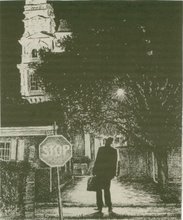
(Polisson Shoe Repair Shop, Stoddart Lane, c. 1940, Cape Ann Museum; Cape Ann Diner, 1972, photograph by Mark Power)


My grandfather, Angel Polisson—we called him Papouli, which is the diminutive in Greek for Papou, or grandfather—had a shoe repair shop in the East End of Main Street, diagonally across from the North Shore Theater in the same alley where A. T. Stoddart’s machine shop was located.

Papouli’s shop was small and dark, even though there was a fairly large window in which he sat to repair shoes. To your left as you entered was a counter behind which his work bench stood. The side of the counter facing him had shelves which held various kinds of leather, shoe nails and shoes that had already been repaid. To your right and toward the rear of the shop was a row of belt-driven machines for cutting, smoothing and polishing new heels and soles. The machines also had brushes for shining shoes. Nearby was a big sewing machine, which looked like a band saw. When Papouli turned the power on to start shaping the new heel of a shoe, the whole shop shook as the machines themselves jumped and rattled.

At the very back of the shop on the left was a glass covered display case full of various brands of wax or liquid shoe polish and sample heels for men and women’s shoes. Above that were additional shelves for shoes awaiting their owners; and against the rear wall was an old couch for customers to sit on while waiting for their shoes or just to visit.

The shop had that characteristic smell of an old-time cobbler’s shop, a mixture of the smells of the different leathers, the waxes and pastes for polishing and shining the shoes or dying the edges of the heels and soles, and the rubber cement, which would be used to fasten on new heels and soles before sewing or nailing them in place. When I wasn’t at my grandfather’s elbow watching him work at his bench, endlessly fascinated by the process of literally rebuilding shoes, which he often did, I would be poring over ancient copies of Life magazine with photographs of the war, just over, or the making of “The Best Years of Our Lives,” or “Life Goes to a Party.” Sometime Papouli would set up a last for me and let me hammer away at an old heel or he’d let me play at “carving” leather with one of the dull knives he must have kept around for such purposes.

The shop also had an unheated back room with a shed attached to it. I would get lost out there for hours, playing with pieces of wood, reading even older magazines, especially National Geographic, making up games in the semi-dark of a late Saturday afternoon—Nick Carter or Lamont Cranston fantasies as I crept down the shadowy cellar steps into what I was certain would be an abandoned crypt, only to be brought back to reality by my grandfather’s voice wondering what I was up to since I’d been so quiet for so long.

In that back room Papouli often prepared tarama, the Greek caviar paste made from fish roe mixed with Italian bread (mashed potatoes can be substituted for the bread), lemon juice and olive oil and chilled after which you can serve it in a salad or as a spread for hors d’oeurves. He made large quantities of it, obtaining the roe locally from Gorton’s, and he would pack it in little wooden tubs, shipping it off to buyers in Boston’s numerous Greek markets. Papouli had stacks of those tubs and I would make several return trips to the back room to stick my fingers into the tarama, never getting enough. To this day, no matter where I eat it, or even if I make it myself, it just doesn’t taste like Papouli’s.

On those Saturdays in the 1940s, when I would “go to work with Papouli,” he would pick me up at 3 Perkins Road and we’d walk to the Boulevard and then the length of Main Street to get to his shop. Like all the older men of the city, he never left home without a hat, which he’d always tip when he met a woman. Once the shop was open he’d tie his apron on and set to work repairing shoes or dealing with the customers. My grandfather was an exacting man, having once been a Greek Orthodox seminarian, and if he didn’t think a shoe could be repaired he’d refuse to take the customer’s money.

Near mid-morning came “mug-up,” which consisted of coffee half-and-half and a chocolate donut at the Hesperus Diner, a few steps up Main Street from the shop. Other times I’d be running in and out of H. C. Brown’s candy and tobacco wholesalers next door with a wooden Indian out front, where Mr. Fraga would give me more candy than he sold me. For lunch—we called it “dinner”—we’d return to the diner. For fifty cents you could order a plate of home-baked beans with fresh cod fish cakes, with lots of catsup on the side. Another favorite was baked macaroni and cheese, which came with fish cakes or the delicious fried cod cheeks and tongues. After lunch Papouli might send me across the street with a dime to catch a Roy Rogers or Lone Ranger matinee at the North Shore Theater. But mostly I’d hang around the shop waiting for certain people who often popped in, like old Captain Brown, who was Portuguese but spoke excellent Greek, or the men from the machine shop who came to pass the time on a break from work. I was too young to be repairing shoes, but I did get to wrap them up for customers in stiff brown paper, though it would be my grandfather who had to tie the string. That took practice.

Those Saturdays seemed to fly. Then Papouli retired and after that he walked with a cane and there were to be no more Saturdays at the shop, which remained empty before they tore it down. Walking by there now I see that everything’s gone except for one of the old houses in the lane and that’s all boarded up. And the alley, which I remember as being such a busy and well-inhabited place ends now in a vacant lot.

2.

Once I'd finished writing about my grandfather’s shoe repair shop, I had a sense I’d left something out, yet I couldn’t quite put my finger on the omission.

I had gotten the shop in, the way the counter loomed chest-high on your left the minute you entered. The shoes were there, too, the ones which had already been repaired and which lay along the window facing Main Street through which you could see the Saturday morning shoppers or the kids in a line for a Sherlock Holmes double-feature matinee across the street at the North Shore Theater.

Then there were the shoes to be repaired. My grandfather would keep them next to his work bench by the window, as I’ve said. Usually he’d save the finishing for last, so that when you came to pick up your shoes he’d polish the heels or the edges of the sole prior to wrapping them for you in brown paper tied with a string.
These details I’d gotten in. And the big Landis machines in a line, too. The noise of them, the rattle and clatter when they started up, the slapping of the leather belts that drove the polishing wheels. There was that and the way the whole shop shook when the machines were going full tilt. I’d also gotten in the smell of everything—the shoe leather, the rubber cement, the shoe polish, the pastes and dyes. I’d even remembered the Greek caviar or tarama, which Papouli made and packed in wooden tubs in the back room and which I couldn’t keep my fingers out of. In fact, a friend recently reminded me that her family used to buy tarama from my grandfather in those days.

I hadn’t forgotten the back room I played in or mug-up at the Hesperus Diner (later known as the Cape Ann Diner), though another friend recalled that where Parkhurst’s radio and TV store is now there used to be the Jonquil Restaurant, and on the other side of the lane where Giles auto parts store is now located, the Pett family had a fruit and vegetable store. H. C. Brown’s, which was a wholesale and retail tobacco store, where I got the penny candy I wrote about, was next to that. And farther down, just before the diner, was a Portuguese market where they sold home-made linguica, which the Greeks called lokanyiko.

So all that was part of the picture I could pull out of the past with my friends’ help. But there was still an omission, I felt. I had told the story I set out to tell. I’d described the places and some of the people who inhabited them on those long-ago Saturdays with Papouli when I was a child, yet I was still dissatisfied.
A few days later while watching some one take out a tall red pack of Pall Malls and light one up, it came to me: “Papouli used to smoke Pall Malls." Yet it wasn’t so much the Pall Malls I’d omitted, though I think having smoked Pall Malls myself for years must have had something to do with watching my grandfather smoke them at his work bench or as he sat reading the Greek newspapers on Sunday afternoons on Centennial Avenue.

It wasn’t the cigarettes themselves or the way he’d hold them European style between index and forefinger, instead of the way most American men held them with thumb and index finger. It was more that by remembering the cigarettes, the distinctive red of the package and the pungent smell of the tobacco, that I’d gotten a much clearer and more distinct, a realer picture of my grandfather himself.

I suddenly recalled how he would appear at our front door every Sunday morning to take my brother and me on a walk to the wharves along Commercial Street and Fort Square. There we would watch the men unloading the fish from the boats just in. We’d stop while my grandfather chatted with some of his old Italian friends. And we’d end our walk at Lufkin’s Diner with steaming cups of coffee half-and-half and the fresh, crisply fried donuts, which might have spoiled Sunday dinner if we hadn’t worked up such an appetite from walking along the waterfront.

I remembered, too, that Papouli seemed always to dress in a dark suit, black or navy blue pin-striped. In winter he wore a gray felt hat, or a Homburg for special occasions. In spring and summer it was a Panama hat. And his thick mustache was sometimes stained by the tobacco from the Pall Malls as were his fingers, which we held on to during our walks.

Papouli was not very tall, but he was a lean man who walked erectly even in his later years or after retirement when he used a cane. He spoke sternly—or at least we interpreted the authority of his Greek, some of which we couldn’t understand, and the patriarchal manner of his delivery as making him stern, even though his eyes would often twinkle behind gold-rimmed glasses.

There he would sit at his workbench behind the counter of the shop, the big, flat-headed shoe hammers, the razor-sharp knives around him, the hat on his head summer or winter, the way Charlie Psalides used to wear his hat in the market on Washington Street or “Uncle Mark” behind the counter at National Butcher’s. And if I return to that picture of Papouli behind his bench or walking with me down Main Street to the shop early on those distant Saturday mornings, it is not to re-tell my story, but only to try and fix its contours with a little more precision, to try to get back in some of the details I’d left out the first time, or that memory had withheld.

Coda

The last time I saw my grandfather he was laid out in his coffin at Greeley’s Funeral Home on Pleasant Street. It was April of 1955. In less than two months I would graduate from Gloucester High School. Papouli was wearing his navy blue pin-striped suit with matching vest. He had on a starched white shirt and a dark blue necktie with white polka dots. I noticed immediately that the tie had not been knotted in his customary fashion. His mustache was waxed and his face was made up in such a way that the wrinkles I knew so well were covered as if by pink-tinted putty. His ashen hands were folded just below his chest. They held a cross on a thin gold chain I had never seen him with.

A heavy smell of gladiolas hung over the room and something more pervasive like perfume. My aunts and uncles sat around the casket in folding metal chairs. Some cried softly, others sat staring into their laps. The Greek priest entered in his vestments and blessed my grandfather, chanting loudly and passing the heavy bronze censor over the body, while the smoke of frankincense permeated the room. Suddenly it felt like church and the old feeling of claustrophobia I had experienced since childhood came over me. I shifted in my chair. Sensing my desire to leave, my mother, who was sitting next to me, gripped my hand as if to say, “Don’t move.”

At the cemetery we all stood around the casket before it was lowered into the ground. For ten years before his death my grandfather had come weekly to tend the plot where he was to be buried along with my grandmother. He had already erected a headstone with their names engraved on it. Only the dates of their deaths were missing. By the side of the tall gravestone stood two small arbor vitae, and there were some plantings near them. After the priest had given his final blessing to my grandfather, he poured some drops of oil on my grandfather’s body from the spout of a bronze cruet, and then he picked up some dirt from the grave and let it fall softly on my grandfather’s chest. The mourners were encouraged to follow suit, ending with my grandmother, who was dressed entirely in black. Finally, when the casket had been closed and was being lowered into the grave, my grandmother stood over the opening.
“Fiyeh o geros,” she said almost to herself, “The old man is leaving."
For many years after that, and even after my grandmother died, driving through West Gloucester I would stop at the cemetery and visit their graves. Sometimes you could hear the voices of the children playing in the nearby schoolyard. Otherwise, it was silent except for the sound of insects in the summer.

Friday, October 9, 2009

Lucy Honig's Waiting for Rescue: A Review


Some writers write engagingly about a single subject, secret codes say. Others—and these include our most versatile—seem able to handle anything with power and panache.


Gloucester resident Lucy Honig, recipient of the prestigious Drue Heinz Literature Prize for her 1999 collection of stories, The Truly Needy, is among the second group. Whether she is writing about homesteading during the final days of the Nixon administration or picking potatoes in rural Maine, about AIDS in Africa, teaching ESL classes in New York City, or a young Cambodian woman’s escape from an arranged marriage, she is able to place her readers in the red hot center of her narratives.


In her new novel, Waiting for Rescue (Counterpoint, $14.95), her first since the Maine Novel Prize-winning Picking Up, Honig takes on another of the significant issues of our times, the effect of the events of 9/11 on those of us who may not have been personally impacted by that tragedy but who have nevertheless been traumatized by the terrorist attacks on the World Trade Center and the Pentagon and their reverberations.


Erika, the protagonist in this compelling novel, teaches writing in the public health department of a major Boston medical school. Her students are health professionals from around the world, “culture-shocked doctors and public officials from countries we call ‘developing,’” as Erika describes them. Her job is to help them articulate, in a language that is often not their own, their approach to research in some of the most pressing health issues of the day—the survival of individuals and families suffering from AIDS in impoverished cultures, the allocation of scarce medical resources in Third World nations, the looming fear of bio-terrorism.


As she struggles to help her students grapple with their research projects, Erika also contends with the interpersonal politics of the department where she teaches—the appointment of a chairperson who is unpopular with the faculty, the rise of incompetent staff, unwelcome changes in her teaching routine. She enters into an uneasy relationship with Ivan, a Russian doctor with whom she works, all the while obsessing over an unthinkable crime committed many years earlier by her former high school biology teacher, who, she learns, has recently been released from prison.


But as Erika’s story unfolds, intercut by her doomed affair with Ivan, the fate of one of her students, Ibrahim, a doctor from Eritrea, who is suffering from cancer, and the ordeal of Faith, a young African girl whose parents have died from AIDS, we discover that Erika is engaged in a deeper existential struggle. She is haunted by the events of 9/11, whose impact on her is brought into shaper focus by her daily struggles with work, her relationship with Ivan and the pain suffered by those around her.


It becomes clear as Honig’s compelling narrative gathers momentum that Erika, like many of us living through the after-effects of 9/11, is suffering from a form of Post Traumatic Stress Disorder. It emerges in her uncharacteristically hostile behavior toward colleagues, her fixation on the crime of her former teacher and her increasingly disturbing dreams of disaster. Sadly, her powerfully rendered journey to Ground Zero with Ivan, coupled with memories of having traveled on the subway under the Twin Towers, when she was a young teacher in New York, bring not closure but further anxiety and dread.


The concluding chapter of the novel, in which Erika travels by bus and by foot through a Boston in violent transition, is a tour de force. It is also a nightmarish vision of post 9/11 America. “This is Boston’s march of progress,” Erika thinks, as she collides with homeless veterans, frenetic shoppers and indifferent investment bankers on their cellphones. “These are our times.” And her thoughts underscore the theme of this stunning and deeply-humane novel.


The author will be reading from Waiting for Rescue on Thursday, October 29 at 7 p.m. at the Book Store in downtown Gloucester.


This review first appeared in the September 29, 2009 issue of North Shore Art Throb, founded and edited by Dinah Cardin.


Monday, August 24, 2009

Charles Olson at the Harbor: A Review


The nationally televised showing on PBS in April and May of Henry Ferrini’s award-winning documentary on Charles Olson, Polis is This, has sparked a renewed interest in the life and work of the late Gloucester poet. Just in time for those who would like to know more about Olson’s fascinating career, or how he came to write his masterwork about his adoptive city, The Maximus Poems, Ralph Maud’s new biography, Charles Olson at the Harbor, arrives, published by Talonbooks, in Vancouver, B.C. (http://www.talonbooks.com)


This beautifully-illustrated and highly readable life of one of the 20th century’s most influential poets, serves as a perfect introduction to Olson’s ground-breaking poetry and prose. It comes further with the cachet of having been written by a distinguished scholar of Olson. Maud, who taught with Olson at SUNY Buffalo, and became close friends with the nearly seven-foot poet before his death, in 1970, has a masterly command of Olson and his work and he wears his learning lightly.


Along with telling Olson’s story and helping new readers to get started on the poetry, Maud’s book offers another benefit—and this one packs a wallop. Maud takes on the only other extant biography of Olson, Tom Clark’s controversial Charles Olson: The Allegory of a Poet’s Life, first published in 1991. Riddled with errors of fact and interpretation, Clark’s life has been the only version available and it has, in Maud’s words, “been at significant variance with truth.” In what he calls a “reactive biography,” Maud confronts Clark, for whom Maud’s superior scholarship and deeper understanding of the poet’s life and work are no match. Friends of Olson and his work, who came away from Clark’s book furious at his misrepresentations, will be pleased to see the record finally set straight.


Maud counters Clark at every stage of his mean-spirited attempt to demean Olson. He corrects Clark’s errors of biographical fact, shows the reader how Clark misquotes Olson to make a spurious point about his character, and he gives us a fuller, more compassionate and understanding portrait of Olson than Clark, who clearly had an animus against the great poet. In fact, one wonders why Clark ever decided to write about someone he clearly disliked, though there is no evidence he ever met Olson or visited Gloucester, where so much of Olson’s life was lived and where his major work was accomplished.


I recommend Maud’s biography to readers, who will enjoy following Olson from Worcester (MA) Classical High School, where he was an honor student and valedictorian, to Wesleyan and Harvard universities, where Olson began the study of American literature and history that would underpin his poetry. From Harvard, Olson moved to Washington, D. C. during WWII, where he worked first at the Office of War Information and then for the Democratic Party. Once Olson had committed himself to poetry after the war, he began teaching at Black Mountain College, in North Carolina, later becoming the experimental school’s rector. When Black Mountain closed, in 1957, Olson returned to Gloucester, where he and his family had summered since the 1920s. It was during these important final years in Gloucester that Olson completed The Maximus Poems, which paid tribute to the “shining city’ he made his own and whose history he believed mirrored both the country’s and the world’s.


Unlike many other poets, Olson had lived a significant part of his life in the real world of politics. His understanding of human foible, carefully illustrated by Maud, animates the poetry. Olson was also an extraordinary scholar. Call Me Ishmael, his ground-breaking book on Herman Melville and the making of Moby-Dick, first published in 1947 and currently available in paperback from Johns Hopkins University Press is still one of the best studies of Melville.


All of these facets of Olson life and artistic career are addressed by Maud, who is respectful of Olson, though not uncritical. The result is a balanced and superbly rendered picture of one of American’s greatest poets. And just when you are asking the question, “Where can I find some of Olson’s poetry to read?” Maud comes forward with A Charles Olson Reader, published in England by Carcanet Press. Maud’s collection contains a generous selection of Olson’s prose and poetry, enough not only to satisfy a reader’s need to get started, but to whet one’s appetite for more. The book also includes highly readable introductory material on Olson and a running commentary on the work that places each essay or poem in the context of the poet’s life and thought.


(This review first appeared in the June 19, 2009 issue of North Shore Art Throb, an internet magazine of the arts founded and edited by Dinah Cardin.)


WHAT DOES NOT CHANGE: The Significance of Charles Olson’s “The Kingfishers.” By Ralph Maud. Fairleigh Dickinson University Press, 1998. $33.50


If Charles Olson were alive today he’d be a happy man. Thanks to the University of California Press, all of the late Gloucester poet’s books remain in print. Four separate volumes of Olson’s collected prose and poetry, including his masterwork, “The Maximus Poems,” are currently available from Berkeley in both cloth and paperback editions. In addition, Johns Hopkins University Press has reissued “Call Me Ishmael,” Olson’s study of the making of Melville’s “Moby Dick,” in an attractive paperback format with a new afterword by Melville scholar Merton M. Sealts, Jr. And both California and Wesleyan University presses will soon publish volumes of Olson’s selected correspondence.


The availability of these significant American texts points not only to Olson’s continued importance as a poet. It also speaks to a renewed interest in Olson as a thinker, not only about verse but about a wide range of historical, philosophical and cultural matters.


Just as Olson’s own works remain in circulation, so do two books that are essential to an understanding of Olson’s poetic and cultural projects. One is “Charles Olson: A Biography,” Ralph Maud’s study of Olson’s life and work through the books that Olson read, already reviewed in these pages. The other is Maud’s new book, “What Does Not Change,” a critical reading of “The Kingfishers,” Olson’s first major poem, long considered a milestone in postwar American literature.


Ralph Maud is the leading Olson scholar and editor of the “Minutes of the Charles Olson Society,” published regularly from Vancouver, BC. He taught with Olson at Buffalo in the early 1960s, maintaining a friendship with the poet until Olson’s death in 1970 from cancer of the liver. Since then, Maud, who is also known as an editor and bibliographer of Welsh poet Dylan Thomas and an authority on British Colombian Native American traditions, has concentrated on documenting Olson’s life and the sources of his work. He has collected a replica of Olson’s library in anticipation of restoring Olson’s home at 28 Fort Square, in Gloucester, as a research center for Olson studies.


It seems fitting, therefore, during the celebration of Gloucester’s 375th anniversary, that Maud’s examination of an essential Olson poem be made available. Not only does Maud help the reader to understand one of Olson’s most enigmatic poems, his examination of the poem’s sources and methods serves equally as a basis for the reading of all of Olson’s subsequent work, especially “The Maximus Poems,” in which the history of Gloucester becomes the history of America and, by extension, that of the world.

Maud’s study serves yet another purpose. It focuses on five crucial years of the poet’s life, between 1945, when in Washington, D.C. at the age of thirty-five he began to write his first poems, and 1950, when Olson’s essay “Projective Verse” was published, changing the face of American poetry. With Maud as guide, the reader experiences Olson’s coming into his own as poet and thinker. Through his careful reading of “The Kingfishers,” we come to understand, in Maud’s words, the poem “as a thoughtful response to the problem of being a sensitive American.”


After World War Two and the revelations of the Holocaust, brought home to Olson by his friend, the Italian painter Corrado Cagli, who had accompanied Allied Units in the opening of Buchenwald, Olson like many writers, asked himself what the future of literature was, if not that of humanity. “The Kingfishers” attempts to answer those questions affirmatively, according to Maud.


For Olson did not want to write another “Waste Land,” T.S. Eliot’s bleak poem about post World War I alienation. He wanted to write about the possibility of connectedness, of belonging, and he wanted to do that not in exile in England, as Eliot had done, but in America, in American terms. That Olson succeeded Maud makes clear. And he is not the first to suggest that a new American poetry began with Olson.


(Gloucester Times, 7/18/98)


Ralph Maud, CHARLES OLSON’S READING: A BIOGRAPHY,

Southern Illinois University Press, 1996, $44.95.


“Charles is just like I am,” Robert Duncan said of his fellow poet Olson. “He sits around and reads all day.” Duncan got it right except for one thing: Olson sat around all night reading. For it was only after the residents of his beloved Gloucester had gone to bed each night that Charles Olson returned to the voracious reading that both fed his mind and fueled his epic of Gloucester’s past, present and future, The Maximus Poems.


From an early age, Olson read “to know,” as he wrote, “to learn!” But he also read to write, as he said of Herman Melville: Reading is a gauge of him at all points in his life. He was a skald (a bard, a historiographer), and knew how to appropriate the work of others.” These words, from Call Me Ishmael, Olson’s masterful study of the sources of Moby-Dick, describe its author as well.


Just as Olson once wrote that he came from “the last walking age of man,” it could also be said that he came from the last great reading age. For Olson hardly ever saw a serious book he couldn’t resist reading. He bought or borrowed books continually, sometimes reading them to shreds, marking them up, beginning letters in their margins, drafting poems on their fly-leaves or end-papers. Many he kept, even if he had checked them out of libraries; some he passed on physically. Always he urged them on friends, writing more about books, or referring to them, than any other source except perhaps his own direct perceptions of the world about him.


Taking as his premise Olson’s need to read, his hunger for books and what they contained, Ralph Maud, professor emeritus of English at Simon Fraser University, colleague of Olson’s at Buffalo between 1963 and 1965, and personal friend of the poet until Olson’s death, in 1970, attempts to tell the story of Olson’s life as a poet through his life in books.


As Maud, in this meticulously researched and written book, says of his subject, “We felt we were in the presence of the man for our time, almost complete in knowledge, and therefore a great resource for a general moving forward.” Maud goes on to explain: “The present work is an attempt to tell in outline—and in some detail as regards Olson’s reading—the story of his this accomplishment came about.


From his own direct experience of Olson Maud says, “I got a sense of what it was like when people left Olson alone to write, enough to sustain my conviction that to follow the evidence of Olson’s reading—the books he kept, the books he stored or gave away, the books that the poems, essays and letters reveal he used, the significant articles in magazines he was sent or read a the drugstore counter or whatever—to follow Olson’s movement within these source works, is the best way to get into the poems, which, as I witnessed, are often a direct extension of his reading.” Maud concludes: “The life of the poet was a life within books.”


Of course, Maud structures his account of the poet’s reading around a chronology of Charles Olson’s life, beginning with the books he read as a child growing up winters in Worcester, Massachusetts and summers “over the Cut,” at a cottage on Stage Fort Avenue in Gloucester. He goes on to describe Olson’s intellectual growth as a Phil Beta Kappa scholar at Wesleyan University and later a graduate student in Harvard’s American Civilization program.


After Olson left Harvard, Maud tracks him through the journal-like entries the poet made in his books to New York City, in the early 1940s, and then to Washington, D.C., where Olson pursued a career in government and politics until 1945. From Washington Olson moved to the experimental Black Mountain College in North Carolina, where he taught a generation of artists, dancers and writers how to read. And then, in 1957, Olson returned to Gloucester to enter deeply into her history, as The Maximus Poems, begun away from the city, took on both a new immediacy, from the poet’s presence at 28 Fort Square, and an even greater particularity, due both to his observations of life around him and his study of local history. By the time Olson had described himself as being “physically...home,” he had, Maud writes, “decided not to be a professor, but only a reader and a writer.”


One might think that a book based almost entirely on Olson’s reading might be somewhat dry. However, Maud is able to recreate the excitement that the poet experienced upon discovering new books or re-reading old ones. “There I was this morning,” writes Olson, in January 1967, “waiting to go to sleep reading Parkman’s Oregon Trail with eyes so open to it I felt like all I might have imagined to be—and that book I dare say I bought in Cambridge 30+ years ago! Slow, sd Charles Olson, he is slow!”


But Maud’s narrative isn’t, nor is the often dizzying pace of Olson’s pursuit of what he needs from books, as Maud tells it. This is a booklover’s book; and for those who don’t know Olson, it’s a wonderful plunge—direct, down, deep into the mind in action of a great American.


(Gloucester Times, 3/28/96)


Wednesday, July 22, 2009

Hemingway Revisited


The publication this month by Scribner’s of a “restored” version of Ernest Hemingway’s posthumous memoir, A Moveable Feast, forty-eight years after the great American writer’s suicide, is a notable event, not only for Hemingway scholarship but also because this more complete version of a significant Hemingway text could introduce a new generation of readers to the work of one of American’s most important writers. In what follows, I attempt an assessment of Hemingway, whose novels and stories I began reading in high school and have continued learning from through more than half a century. I conclude with some thoughts about the new version of A Moveable Feast. The first two sections of this essay appeared in slightly different form as columns in the Gloucester Daily Times.


Sooner or later you come back to Ernest Hemingway if you are an American writer. You come back to Hemingway as you come back to the novels of Herman Melville or the poetry of Emily Dickinson or Wallace Stevens. You come back to those writers who meant something to you, not only in your craft but in the way they transformed your means of looking at the world.


There are writers like Thomas Wolfe, whom you can never read again; writers you cannot go home to because you have outgrown them. And their attraction for you was based on what you needed from them at a certain stage of your development. There are writers like Faulkner, whom you find it difficult to read again, but you always know they are there and you look back with respect for what their achievement taught you.


There are writers of a particular time and place, like Josephine Herbst, who wrote about the 1920s and 30s. Such writers often read better now because the struggles they depicted, the issues which motivated them to write, are no longer of such moment. It is then you discover how fine a writer Herbst was—she who was overshadowed by Dos Passos and Hemingway, though it was Herbst who went to Cuba first and then to Spain; and it was she who stuck to her socialist ideals, dying finally in 1969 after living for years in obscurity in a stone farmhouse in Pennsylvania.


Since his death in 1961, six major biographies of Hemingway have been published, beginning with Carlos Baker’s groundbreaking Ernest Hemingway: A Life Story (1969) and concluding with Michael Reynolds' definitive five-volume sequence, Hemingway (1986-1999), and James Mellow’s magisterial Hemingway: A Life without Consequences (1992), the third volume in his Lost Generation trilogy and the best-written and most critically brilliant of all the Hemingway biographies. Perhaps the time has finally come to consider Hemingway the writer and not the caricature that was made of him in the Media or by critics, who felt the need to attack him personally or for the myth that grew up around him, partially at his own behest, which obscured the exceptional work he did.


Six books published posthumously show Hemingway working right up to the end of his anguish. These include A Moveable Feast (1964), Hemingway’s poignant memoir of his Paris years, Islands in the Stream (1970), a seriously flawed abridgement of a massive novel Hemingway worked on after the war and left incomplete, True at First Light (1999) and Under Kilimanjaro (2005), two versions of a manuscript about Hemingway’s last visit to Africa, The Dangerous Summer (1985), a first-hand account of the competition between the bullfighters Antonio Ordonez and Luis Miguel Dominguin during the summer of 1959, which appeared first as articles in Life, in 1960, and The Garden of Eden, an abridgement of a long novel in which Hemingway returned to his Paris years.


Edited from an immense manuscript, The Dangerous Years is Proustian in its detail and in the author’s attempt to recapture the lost part of his life in Spain before the Civil War. It is also vintage Hemingway. It shows the mature writer working near the top of his form in the face of crushing depression and the emerging paranoia accompanying the psychosis that led to his suicide, on July 2, 1961.


I approached the published fragment of The Garden of Eden (1986) with some trepidation. I had seen a couple of reviews, a silly one in the New York Review by Wilfred Sheed, and a generous one by E. L. Doctorow in the New York Times Book Review. I was somewhat reluctant about reading a book that was not published with Hemingway’s consent or in the way he finally left it. I couldn’t read Islands in the Stream for that reason. And ultimately when I felt the need to return to Hemingway, I went back to his stories (Philip Young published a superb collection of the Nick Adams stories in 1972, and in 1987 Scribner’s brought out The Finca Vigia Edition of The Complete Short Stories of Ernest Hemingway) and the two earliest novels, The Sun Also Rises and A Farewell to Arms.


I am not as troubled as some critics have been by the way Hemingway depicts relationships or sex roles in those early novels. They are of a time and place; they describe behaviors and attitudes common to that era and not unknown in our own times. They render a consciousness that was as pervasive as our hopefully less sexist consciousness is now. Hemingway’s characters are also a projection of his own psyche. To ask them to be different is to ask for Hemingway to have been a different, less conflicted, and, as such, a very different kind of writer (see Nancy R. Comley and Robert Scholes’ Hemingway’s Genders, Carl Eby’s Hemingway’s Fetishism, and Hilary K. Justice’s The Bones of the Others for three recent provocative critical views of Hemingway’s sexuality as it played out in his fiction and his life).


To ask Hemingway or Fitzgerald, Gertrude Stein or Kay Boyle, or even Josephine Herbst, who was both a feminist and a communist, to be what they were patently unable to be, or to write in a manner which would have been alien to them, is an impossibility. And those who condemn Hemingway for the regressive sexual attitudes they find, or think they find, in his stories or novels are missing the entire point of his work. They are missing the voice of the writer who can speak to us across the years as clearly and as directly as he spoke in 1925 or 1936. They are missing an angle of vision, the revolutionary ability of a writer who developed the technique to help him render the absolute quality and texture of the physical world while also expressing the emotions of the observer. They are losing sight of the Hemingway who could write like this:


In the fall the war was always there, but we did not go to it anymore. It was cold in the fall and the dark came very early. Then the electric lights came on, and it was pleasant along the street looking in the windows. There was much game hanging outside the shops, and the snow powdered in the fur of the foxes and the wind blew their tails. The deer hung stiff and heavy and empty, and the small birds blew in the wind and the wind turned their feathers. It was cold in the fall and the wind came down from the mountains. (“In Another Country)


2.


There is nothing you can do except try to write it the way it was. So you must write each day better than you possibly can and use the sorrow that you have now to make you know how the early sorrow came. And you must always remember the things you believed because if you know them they will be there in the writing and you won’t betray them.

(The Garden of Eden)


Twenty-five years after Hemingway’s death and forty years after he began to write, The Garden of Eden appeared. It was published by Scribners as a complete novel, although it was only part of a much longer manuscript of 1,500 pages left incomplete at the writer’s death on July 2, 1961. Yet I read it with pleasure, as soon as it was published, and with a sense of discovery. For what I found in the book, wonderfully and unexpectedly, was growth.


I found a stretching of the writer’s vision, a tenderness and a depth of feeling that demonstrated to me that Hemingway had not become frozen in old patterns of thought or regressive ways of rendering the world and the people in it, as many had believed. Looking back on that excited first reading, I can only wish the novel had been completed as Hemingway obviously hoped to conclude it. Still, there is much even in this truncated version that makes it worthwhile to experience, even though one recognizes immediately that some of the dialogue is loose and Hemingway would certainly have fine-tuned it, or that there must have been more context to the novel, which is now missing in the excavation by its editors of one single story from a much longer text.


There is some wonderful prose in The Garden of Eden, indeed some of Hemingway’s best writing. But it’s clear that the book as published is only a fragment of a larger design, a more complex narrative. Nevertheless, it works as a story. There is a fine tension between the writing life of its protagonist David Bourne—his struggle with his craft and with the use, the recovery and understanding of his past—and his strange marriage, including the sudden appearance of a second woman, Marita, with whom David and his wife Catherine both become involved. Indeed, there is a psychosexual dimension to the novel that helps the reader to understand much of what might have seemed enigmatic or ambiguous about certain relationships in early Hemingway stories and novels, including an intriguing fetishism around male and female hair styles.


The novel also contains some rich insights into the art of writing, as Hemingway returned in the narrative to the years in France when he had honed his style to perfection and was doing some of his finest work. It is probably Hemingway at his best on writing, on what it feels like to be a writer; on your relationship with your craft, your respect for it and for yourself when you exercise that craft with care and accuracy. Coming it as did, twenty-five years after the writer’s death, the book and its insights proved a wonderful gift to the reader.


Part of the problem with understanding or appreciating Hemingway is that we believe we have known him for a long time. We’ve read most of his writings and we know a great deal, or think we do, about the man himself. What once startled and shocked, what we admired and loved about his unique prose, his vision, is now a matter of everyone’s experience. Other writers, as diverse as Norman Mailer and Raymond Carver, have learned from Hemingway as he, in turn, learned from Henry James, Joseph Conrad, Gertrude Stein and Sherwood Anderson; and they’ve gone on to make another kind of writing, which is as it should be.


Yet we mustn’t allow that necessary evolution and development in the novel, in the shared craft of writing (a development which Hemingway’s struggle with language made largely possible) to obscure his real achievement. We must try to go back and understand that achievement for what it was; see it in its own historical, social and aesthetic context. Then, I think, Hemingway emerges as the truly revolutionary writer he was.


Some of the evidence of Hemingway’s achievement you will find in The Garden of Eden. It’s almost as though Hemingway was compelled to visit his old ground of first success as a writer, just as David Bourne revisits Africa in his story to try to discover what, as a boy, had made him the man and the writer he would become. In revisiting that ground, Hemingway tried to revise what he had previously written, to relive what had gone into some of his earlier writing, including what scholar and critic Mark Spilka calls his “quarrel with androgyny.” And he did this not to repeat himself, I suspect, but to grow beyond what he had previously achieved. The result is quite moving and should be sobering to any writer who cares to learn from it.


I believe that long after many of today’s fashionable writers are forgotten, people will be reading about Nick Adams waking up on a sharp Michigan morning or about the little waiter in “A Clean, Well-Lighted Place,” who met the nada of existence with the acceptance and grace of the very brave. Long after the myth of Ernest Hemingway has receded, people will encounter his work with that sense of discovery you experience with writers who have transcended time and fashion.


Some of those readers will still wonder, as we do today, about the cost at which those stories and novels were achieved. For, as another American writer very like Hemingway noted, nothing comes in this life without cost. No knowledge is gained without consequences or the requisite amount of life exchanged for it.

You don’t live without risk anymore than you can expect to grow without pain. You don’t achieve insight into yourself or love the clarity of certain spring mornings, the depth of summer nights, without a concomitant sacrifice in some other part of your life. Hemingway taught us that, among many other things. Perhaps it is a good time now, nearly fifty years after his death, to acknowledge our debt to this great American writer.


3.


I know no better way of acknowledging this debt to Hemingway than by re-reading him or discovering his prose for the first time. Were I teaching Hemingway, as I did so many times at the high school and college levels, I would recommend beginning with the early stories, some of which I have mentioned above, and the first two novels (it is interesting to note that both presidential candidates in 2008 named For Whom the Bell Tolls, Hemingway’s 1940 novel of the Spanish Civil War, as one of the books that had the most impact upon their lives). I would also recommend the “restored” version of A Moveable Feast, Hemingway’s posthumously published memoir of his years in Paris during the 1920s. While the book is by no means complete—Hemingway left the manuscript without an introduction or a final chapter, and several subsequent chapters remained in draft form—it is still classic Hemingway, and this new edition attempts to present the book just as he left it. The 1964 version, edited by Hemingway’s fourth wife Mary and his former editor at Scribner’s, is a smoother text; but that apparent smoothness has been achieved at the expense of patching together fragments from disparate chapters, so it is better, in the final analysis, both for Hemingway aficionados as well as for new readers, to have the text exactly as it came from Hemingway’s hand.


That said, there are some wonderful gems in this book, not the least being Hemingway’s breathtaking descriptions of the city in which he began his career as a writer:


Then there was the bad weather. It would come in one day when the fall was over. You would have to shut the windows in the night against the rain and the cold wind would strip the leaves from the trees in the Place Contrescarpe. The leaves lay sodden in the rain and the wind drove the rain against the big green autobus at the terminal and the Café des Amateurs was crowded and the windows misted over from the heat and the smoke inside. . .


All of the sadness of the city came suddenly with the first cold rains of winter, and there were no more tops to the high white houses as you walked but only the wet blackness of the street and the closed doors of the small shops, the herb-sellers, the stationery and the newspaper shops, the midwife—second class—and the hotel where Verlaine had died where you had a room on the top floor where you worked.


There are chapters on his relationships with Ezra Pound, Gertrude Stein, Ford Madox Ford and F. Scott Fitzgerald, writers who helped, influenced or inspired the young Hemingway. Some critics have found Hemingway’s treatment of these relationships mean-spirited, vindictive even; and the persona of Hemingway that emerges in this book, of an American innocent corrupted by the rich, is often not a pleasant one to encounter. Still, there is an incredible sense of loss that pervades the narrative, not only the loss of that incorruptibility Hemingway exhibited when he first arrived in Europe, but of his first marriage to Hadley, which is described in heartrending terms (“Winters in Scruns,” the chapter in which Hemingway confesses his betrayal of Hadley, is for me the finest in the book).


Hemingway was becoming a very sick man when he began the composition of this book, in June of 1957. He and Mary had survived two plane crashes in Africa, and his head injuries had left him deeply depressed. He suffered from vascular problems, from a sense of waning literary power, after not having been able to complete any subsequent writing project to his satisfaction, and his alcoholism worsened. He became paranoid and he alienated many old friends. It was this Hemingway who sat down to write about his early years in Paris and his state of mind certainly colored both the way he remembered those years and the way he wrote about them.


And yet, for all the pain Hemingway suffered, the debilitating depressions and the incredible sense of guilt and loss, he persisted in writing the Paris sketches that we have today, leaving us, in the process, some of his finest prose. As Hemingway wrote in one of the fragments left out of the final manuscript but included in this new edition, along with ten unpublished sketches:


There is never any ending to Paris and the memory of each person who has lived in it differs from that of any other. We always returned to it no matter who we were or how it was changed nor with what difficulties nor what ease it could be reached. It was always worth it and we received a return for whatever we brought to it.


I believe the same can be said for Hemingway’s writing.


_____________

For a biopsychosocial view of Hemingway's life, see Christopher D. Martin, Ernest Hemingway: A Psychological Autopsy of a Suicide, Psychiatry 69(4), Winter, 2006. Martin's conclusions, in summary:

Significant evidence exists to support the diagnoses
of bipolar disorder, alcohol dependence, traumatic brain injury, and probable
borderline and narcissistic personality traits. Late in life, Hemingway also
developed symptoms of psychosis likely related to his underlying affective illness
and superimposed alcoholism and traumatic brain injury. Hemingway utilized a
variety of defense mechanisms, including self–medication with alcohol, a lifestyle
of aggressive, risk–taking sportsmanship, and writing, in order to cope with the
suffering caused by the complex comorbidity of his interrelated psychiatric disorders.
Ultimately, Hemingway’s defense mechanisms failed, overwhelmed by the
burden of his complex comorbid illness, resulting in his suicide. However, despite
suffering from multiple psychiatric disorders, Hemingway was able to live a
vibrant life until the age of 61 and within that time contribute immortal works of
fiction to the literary canon.


Thursday, July 9, 2009

Michael Jackson: A Backward Look


The recent death of pop music idol Michael Jackson sent me back to my files in search of a column I had written during the spring of 1984 when Jackson was about to appear in Boston during his highly touted “Thriller Tour.” I reproduce it below exactly as it was published in the Gloucester Daily Times.


“He’s coming to town!” read the headline on last Saturday’s Boston Herald.


The “He” referred to was not God or Christ for whom the non-specific capitalized personal pronoun is traditionally reserved. It was none other than pop star Michael Jackson. And for the thousands of fans in the Boston area whose sole preoccupation seemed to be whether or not their idol would appear here, there was presumably no need to say any more than was indicated by the cryptic headline.


You either knew what it meant or it didn’t concern you. All else—the heightened tensions in Lebanon, the Iran-Iraq war, or the president’s vicious proposal to lower the minimum hourly wage on summer jobs for those kids who most need the money and who also constitute Jackson’s largest group of fans—was relegated to the back pages, if it was mentioned at all.


Jackson was front and center. It is a position only fortified by his May appearance in the Rose Garden. There he was given the presidential seal of approval in return for lending his name and face to a long-overdue anti-drug and drinking campaign aimed at teenagers. Indeed, there seems to be little question that the country is in the grip of another craze, one that appears every bit as pervasive as that initiated more than 20 years ago by four young mop-headed working-class boys from Liverpool, England.


The Beatles began first by reproducing American rock n’ roll and recycling it back to us. Their early music was clean and hard-edged and it caught on fast. They soon revealed themselves not simply as imitators but as artists in their own right. In the process, they took most of their fans on that Magical Mystery Tour that lasted through a number of highly creative y ears. They also added to their devotees millions of older people like me, who came originally to scoff at the music our high school students were listening to instead of reading Silas Marner. But instead we stayed, not only to listen ourselves, but to be enthralled by their humor, their ability to grow and their extraordinary political and social consciences.


Years after they disbanded and after the tragic murder of John Lennon, whose creativity seemed only to expand with time, one could still listen to their music and find new things in it. It was also a pleasure to find one’s own children listening to the music we loved rather than laughing at it and us, as we often did with our parents and their generation’s music.


Michael Jackson is an altogether different sort of performer. His music is different, too. It’s far more commercially oriented, lavishly orchestrated, dramatic in its electronically modulated effects. With the advent of MTV Jackson has an entirely new medium for the extension of his music and for reaching vast audiences.

There’s no question about his talent as a singer or dancer. But that talent seems to lend itself to exploitation like a jewel overwhelmed and ultimately engulfed by its setting. When all is said and done, when MTV is off, the record over, or the radio playing another production, there is no resonance. You have to hear the song again, wait again for the segment to appear on MTV, play your record again, or buy the next one.


Jackson’s music depends upon its reproduction, upon the habit it has conditioned in its listeners, not upon its essential impact. A Michael Jackson song or performance does not change its listener. It does not make you see the world or yourself differently, as many Beatles songs did. It does not refer you to something outside of it or yourself. It is entirely reflexive, self-enclosed and self-perpetuating. It leads only to repetition or to another production like itself. It ultimately creates consumers for itself and for the packaged myth of the performer and his carefully orchestrated persona rather than an enlightened audience.


The Beatles were a craze—there is no question about that. They were exploited by the media and the music industry. But they exploited them in turn, using their immense popularity and the money they earned to make music, which the record companies before their time would never have risked producing. They also used their public prominence to espouse important causes and to raise the consciousness of their audience. They put their lives and their talents at the service of more than the music industry or their own personal wealth.


Time and time again, in ways both personal and musical, the Beatles undermined those who set out to exploit and to market them. They transcended the spectacle which they were being forced to participate in and which the larger society had become—that life which is lived at a remove from itself and entirely at the level of image. It is a life which depends not upon what is creative in each one of us but what has been created for mass consumption.


One could not imagine the Beatles being received by Ronald Reagan. Their own Queen acknowledged them only because they increased Britain’s GNP. But then, 20 years ago, one could not have imagined a Reagan presidency. That, like the Michael Jackson phenomenon, can only become possible when the spectacle displaces reality and we are all hooked into MTV and not into each other, our neighborhoods, our towns, our nation or ourselves.