Tuesday, April 28, 2009

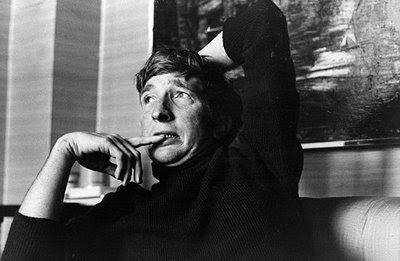
Jonathan Bayliss (1926-2009)


(Photograph by Mark Power)

I met Jonathan Bayliss 47 years ago this month. We were invited by Charles Olson to read at Gallery Seven in Magnolia, a contemporary art gallery that sponsored readings by poets and writers. On that unseasonably warm April night, I read first from a novel I’d been working on, set in Italy. John Keyes, a New York poet, then living in Gloucester, read from a long Olson-inspired poem about his hometown of Washington, D.C.


The final reader was a youngish, balding man of thirty-six, wearing a business suit. Olson introduced him as Jonathan Bayliss, a novelist and playwright, who worked as a market analyst at Gorton’s, having moved with his family to Gloucester in 1956. Jonathan had with him the thick manuscript of a novel-in-progress, set in Berkeley and San Francisco; and he proceeded to read from the beginning, titled appropriately “Prologos:”


Michael Chapman had not cherished any of his three sons before they were born nor had he hoped for them before they were conceived. Ruth Chapman the wife and mother agglomerated them licked them into shape and bred them up for his approval. Except when gripped by a universal pathos of babyhood he had been nearly careless of each undifferentiated babe in the cradle. But he found that humankind’s uniqueness entered his history as engagingly as any less casual father’s. In every case the gathering person of a child’s incorporated him against his will as if without warning.


At first I thought, “Well, this is quite old-fashioned,” but as Jonathan read on, I and the rest of the audience became spellbound:


In the years of growth as the new people in the family nourished their possibilities partly on the father’s protein his own possibility continuously diminished. One by one they joined their mother in pruning and oiling the plumage by means of which he personally might have fledged. It was not in themselves that they embarrassed him, not by virtue of existence or intention, but by the statistical fact of their economic connections. Their organic requirement prevented further exfoliation on the father’s part. At the age of thirty-three all he had left to himself was the inner man.


Not only was Jonathan’s prose stately and beautiful in its exquisitely formal cadences, it was humorous, and it was subtle. On the surface it seemed to reflect, even mimic, the prose of certain 18th century British novels—Sterne’s Tristram Shandy came immediately to mind—yet there was something quite modern about it, indeed Modernist, in the sentences’ paucity of punctuation, the irony inherent in their diction, the inflation of the domestic subject into myth. Jonathan continued:


Yet there was nothing unsure about his love for the three who loved each other and both parents. His love was crescent and irreversible, a moon that never waned and always grew, even when obscured by clouds of annoyance or despair—not like the moon of his love for the mother, which in the course of the years waxed only haltingly, with countless fluctuations, magnified chiefly by complexity of perception.


As he entered more deeply into his narrative, a sense of the form of this book in gestation, the trajectory of its narrative, began to take shape. The longer Jonathan read in a quiet, sometimes faintly audible voice, the more I realized that his was not an old-fashioned book at all. In fact, it was revolutionary. I could hardly contain my excitement.


After the reading that night at Gallery Seven, after Olson had introduced Jonathan and me; after Olson had been heard to exclaim that Bayliss’s novel might be one of the most important then being written in America; and after some of us had repaired to Olson’s house at 28 Fort Square for the first of many nights around that kitchen table, which Olson referred to as my “graduate school,” Jonathan and I initiated one of our countless talks that would spread over 47 years and be among the greatest delights of my life.


We felt an immediate affinity, Jonathan and I, not only because we were both engaged in the writing of novels, but because we discovered that we were attracted to many of the same writers—the great British novelists of the 18th century, and some of the more eccentric ones of the 19th and 20th centuries, George Gissing, Ford Madox Ford; not to speak of Europeans like Hermann Broch and Robert Musil, whose novels inspired both the reach and the structure of Jonathan’s. We also had William Butler Yeats in common, on whose plays, in particular, Jonathan had done graduate work at Berkeley. Then would come Melville, Jonathan’s deep study of whose novels and poems benefited me immeasurably in the years to follow.


That first night at Olson’s we agreed to meet and read to each other from our ongoing work. And we did so each Friday night in Jonathan’s study, secluded on the top floor of his house at 165 Washington Street, overlooking Oak Grove cemetery. In that book-lined room, redolent with the smell of his pipe tobacco, where Jonathan wrote at a heavy, dark-stained wooden table on an old manual typewriter, we took turns sharing with each other our latest chapters. As Jonathan expanded his narrative, I began to understand the complexity of its structure and of his own mind, which I could only marvel at. Ultimately, we came to realize that we were, or were going to become, quite different writers. Encouraged by Jonathan, I began to find my voice as a social realist, while Jonathan evolved into one of our great maximalists, his novel exfoliating from a bourgeois family story to the vast Pythagorean structure it became, as it expanded to include the systems of ritual and myth as they mirrored the systems of science, cybernetics and business. But I think we helped each other in those early years before our personal lives diverged. Certainly Jonathan helped me, not only through the education I received listening to his evolving novel, but through our talk about books, politics and philosophy.


Jonathan had—and Olson firmly believed this—one of the finest minds in America. Olson also claimed that Bayliss, as he always referred to him, was “the only person in the country who understands me,” while Jonathan, in his unerring candor, was one of the few who dared stand up to what he sometimes referred to in person and in the margins of Olson’s books as Charles’s “BS.” Compared to Olson’s monumental assaults on knowledge, Jonathan’s scholarship was patient and circumspect, though no less deep and thorough, as befitted the Harvard student, who followed his great teacher, the scholar, critic and biographer Mark Shorer, to Berkeley after the war.


As to Jonathan’s demeanor in those years, he was often quiet, reticent, even shy. Who could be otherwise around Olson and Vincent Ferrini, confronted with the drama of their personal lives, the agony and ecstasy of creation, the endless dialectics that sometimes exhausted the rest of us as we talked and drank far into those starry Gloucester nights?


Let me share one story: We were at Jonathan’s on a stormy early winter night, Vincent, Charles and I, sitting around the dining room table, as we often did, Doris and the children all in bed by then. There was talk of JFK and the recent Cuban Missile Crisis, of the direction of the Democratic Party, Charles having spent years in the thick of Washington politics. The subject turned to Joyce, not a favorite of Jonathan’s or Charles’, veering then to Jonathan’s novel. In a characteristic gesture, Charles stood up, gripped the table and said to Jonathan, “I’ll do whatever I can to see that your book gets published.” Embarrassed, as he often was by compliments, by any attention paid to him, Jonathan demurred in the face of Olson’s mounting enthusiasm. Offended, Olson stopped short in his praise. He slammed his glass down.


“Bayliss, I’m leaving your house,” he said, turning from the table to put on the huge overcoat, which Jonathan would later describe as “the mantle of [Olson’s] respectability.”

“No, Charles,” Vincent and I shouted. “Stay, stay! It’s only a misunderstanding.”
But Olson left in a huff, stomping out into the snow, as we watched his massive form disappear down Washington Street.


“I didn’t mean to hurt his feelings,” Jonathan said, after we resumed our places at the table. Vincent and I quickly jumped in to reassure him that he had done or said nothing wrong. We attempted to return to our conversation, but Olson’s absence created a void that we three could not fill. At once, Ferrini got up. “Let’s go to Charles’,” he suggested. So the three of us traipsed out into what had now become a blizzard. We slogged through the driving snow from Jonathan’s house, across the railroad tracks, down past Washington Square and Gould Court, past Joan of Arc and the Legion Hall, and onto Commercial Street. When we reached Fort Square, the plows had not yet come through and the snow was a couple of feet deep.


Up Olson’s flight of steps we charged, wind and snow lashing our faces. Ferrini knocked on the kitchen door and Charles, wrapped in a big blanket, answered. At first he scowled, and then, warmed by our attempt to succor him, he let us in. The heat from the gas-on-gas stove melted the snow from our coats. We hugged; Jonathan apologized for seeming to reject Charles’ generous offer; Charles forgave him. We sat down at the kitchen table, littered with Olson’s daily mail yet unread. A bottle appeared and the night continued as if there had been no interruption. And all through this, Olson’s wife Betty and their son Charles Peter slept soundly.


Jonathan has been characterized in his obituaries as being as committed as a writer and business executive as he was as a father. To this I can attest, having spent so many hours in his house on Washington Street with his family at impromptu dinners at which the famous “Spaghetti Bayliss” was featured, or on quiet evenings of unmoistened talk. Jonathan read to his three children, Cathie, Vicky and “Geeka,” as I knew them then. He took them to the movies and to concerts and plays. This man, who carried a shirt pocket full of used punch-cards on which to record the rush of his ideas, was ever accessible to his children.


Flaubert, the father of the modern novel, insisted that writers “Be regular and ordinary in your life, like a bourgeois, so that you can be violent and original in your works.” Jonathan was the most gentle and self-effacing of men, polite, deferential, thoughtful and considerate of friends and family. He dressed and lived conservatively, frugally, almost invisibly: the complete bourgeois. He was a lifelong Democrat. He confessed to me that he’d once voted for Henry Wallace and immediately regretted it. He opposed the war in Vietnam, yet he continued to support Lyndon Johnson; and once, when I pressed Herbert Marcuse’s One-Dimensional Man on him, he returned the book with a quiet, though dismissive, shake of his head—“He’s a Platonist,” Jonathan said, and that was the most devastating rejection anyone could receive from him.


And yet in the writing Jonathan soared. He grappled with complex ideas, he explored archaic and post-modern structures, and, like Joyce, he pushed the English language to its limits. The diction of his novels is not your demotic American. In Jonathan’s hands our native tongue becomes a richer medium, precise yet imaginative, playful yet knowing, “not by simplifying the complexity of English,” as his narrator in Gloucestertide explains, “but by fixing more dimensions of abstraction.” For Jonathan, the novel was still “our quintessential medium of experience.” In the end, the games of words and identities he posed, the structural puzzles, the myths and counter-myths, systems and meta-systems—indeed, the counter-factuality of reality, as he limned it—were only one level of the play of Jonathan’s remarkable intelligence, an intelligence that had for long been missing from most American fiction. The other level is the writing itself—for Jonathan was a writer above all else—often breathtaking in its lyricism. I will close with one such example from Gloucestertide, one of his evocative descriptions of the city that became his actual and spiritual home and the source of his work:


Between every two beaches here on our stone island, between harbors and coves, wherever the land stops the sea, those tawny anfractuous rocks are a jagged pathway of choices. At chaotic elevations, with footholds on irregular cusps at all angles, no step is predictable until your foot is in the air, no step is determined by habits of graceful continuity. From ledges and pinnacles, on whalebacks and whalejaws, you fling yourself across one crevasse to another in jerky motion, sideways and forward, sometimes switching back to descend a crag or traverse a tidal gorge, sometimes down to a tongue of popples, at the lower tides always keeping above the slippery seaweed. Each imbalance is corrected by the next…It feels as if you’re rapidly covering great distances. Your dazzling way is bleached by salt and sun. It’s impossible to stop and think. Yet all the while you are both spectator and center of attraction for surf below, clouds above, and boats in the offing.


(This eulogy was delivered on April 27, 2009, at a memorial service for Jonathan Bayliss, at St. John's Episcopal Church in Gloucester, Massachusetts.)

Monday, April 20, 2009

Broken Trip: A Review by Richard M. Amero


Broken Trip (Glad Day Books, 2004) by Peter Anastas consists of ten short stories that are tied together because they interact with the professional activities of Tony Russo, a welfare case worker, who provides his clients with shelter, food, medical treatment, and pats of encouragement. Reading the book is something like drinking a martini. At first one feels the astringent taste and then the BANG hits you. Not all the stories have the same punch, but as a group they pack a stunning wallop. There is so much agony, suffering and loss among some of the characters that they remind me of sinners in Dante’s Inferno, whose obsessions were similarly painful and everlasting. Perhaps a saving factor in this collection of down-and-out stories is that they end, as poet George Oppen puts it [in an epigraph] at the beginning of the book, in a place where all human emotions ultimately founder.


While the book has a Gloucester setting and most of the characters are involved with the demise of the fishing industry, there is more to the book than Gloucester, for its basic theme is poverty of body and mind, a poverty that reaches across America and the world. Some of the people depicted are as horrible as human beings can get, short of Buchenwald. While not an intellectual novel on the surface at least (remember the delayed reaction), nurses Amanda and Rochelle, in “The Psyche Unit,” represent opposite points of view regarding the question: Is it mind or is it environment that dictates human behavior? Since so many of the damned are dope addicts, the answer would seem to be environment and the treatment DETOX. Yet, by itself, the treatment doesn’t work, so the force of consciousness can be brought into play. That is why nurse Rochelle grieves over the suicide of Terrence, a junkie, who demonstrated insight but could not control his destructive urges.


The most interesting character in the book for me is Larry, Rochelle’s understanding husband. For all his good will, Tony functions as a device. It is through him that the stories are told in a concise reportorial manner that shifts from inner thoughts and outer taunting dialogue. Tony may understand the world, but Larry sustains his wife Rochelle, who has had to cope with abuse from her dope-afflicted mother and Roy, her mother’s lover, and her murder of Roy. Why does Roy act as he does? Why do most dope addicts act as they do?


The Gloucester emphasis appears most prominently in “Skag,” (heroin). Here the most unlikely of trios go out to sea in a once-in-a-lifetime trip to catch cod on the Stellwagen Bank. The miracle is that they succeed. There is a wisp of Hemingway’s Old Man and the Sea in this section, but the wisp soon merges into a story of victory not over the sea but over self. All three men—Shitter, Frankie and Jimmy, but principally last-minute replacement captain Jimmy—achieve a victory that is more substantial than Terrence’s defeatist views of himself. Like the hired man in Frost’s great poem, Jimmy prepares to die with the sense that at sea he has at least conquered—or forgotten—his demons. Perhaps here is the answer to why men, from time immemorial, have gone down to the sea in ships. In doing so, they escape from the exactions and turmoils of land for work that is so bracing, energetic and dangerous that they forget themselves. This is the HIGH addicts don’t have and the reason they go to sea instead of to the lab.


There are many surprises in Anastas’ book. His criticism of the Department of Public Welfare, now changed to Department of Transitional Assistance, is justified at least for people who accept the burden of being their brother’s keeper. It is not Gloucester alone that produces a class of half-civilized or worse people. Anastas doesn’t dwell on the people in the barrooms and on the belt lines in fish factories; but these nameless people are as lonely, bored and unhappy as the principals and spend too much of their time sniping about the actions of their neighbors.


One of the bigger surprises is that the drugs that infest Gloucester and, for that matter, all of the Massachusetts North Shore, do not come from the fishing boats—though some do—but from dealers in Boston. The book does not propose a cure for addiction, unless it be through methadone, therapy and analysis. Except perhaps for Tolstoy, there is no reason why a writer of a naturalistic work of fiction should try to solve all the world’s problems.

Finally, “Has Gloucester changed and not for the better?” The “Broken Trip” is when a boat returns without fish. Anastas does not give alternatives; but certainly the 19th and 20th century fishing town of Gloucester has changed. As counselor Julie in “Getting Straight” says to Jade, who claims she never gave her long live-in companion “Doc” love, “Love is a lot of things.” By the same token, some portion of the degraded, desperate and deranged underclass in Gloucester may, like Rochelle, arise from the wallow, the filth and the stench. As Dante has written, after the Inferno is Purgatory. For most of us Paradise is out of reach.


(Richard M. Amero is a writer and historian, who lives in San Diego. A Gloucester native, Amero attended Black Mountain and Bard colleges. He was a prime mover in the restoration of Balboa Park and has written extensively on the park, on San Diego and California history. His writings, including essays on Melville, Hawthorne, Thoreau, Hart Crane, James Joyce, Dostoevsky and the Gloucester novelist and playwright Jonathan Bayliss, can be found on his website http://www.balboaparkhistory.net)


Salem News, April 8, 2004

'Broken Trip' a compelling,
brutal tale of North Shore
life

by Rae Franceour

Broken Trip

By Peter Anastas. Glad Day Books, P.O. Box
699
, Enfield, NH 03748
, 2004. 250 pages. $16.

Will Gloucester survive the slow, torturous
decline of its fishing industry? On the eastern
edge of Boston's North Shore, this rugged,
breathtakingly beautiful city is amassing a body
of its own literature. Gloucester's stories are
notable for their depiction of a heroic culture that
in recent decades battles despair.

Peter Anastas, a Gloucester resident himself, has
brilliantly chronicled the struggle in Broken
Trip, an unusual book that straddles fiction and
nonfiction. For lack of a better name, it is labeled
a novel. And though there is some continuity
provided between chapters, it is really a series of
telling episodes in the life of Gloucester and some
of her people. Love, loyalty and family; drugs
and alcohol; fishing; incest and violence; poverty
and its accompanying depravity are strong
themes in this deceptively easy to read, but hard
to digest book.

As the recently retired director of advocacy and
housing at Action in Gloucester, Anastas is
acutely attuned to the hardships this city endures.
His book's title, Broken Trip, is a localism for a
fishing trip that doesn't meet expectations due to
weather, technical problems, or lack of fish. And
though Anastas wears many hats on the North
Shore
- intellectual, frequently published author,
father of the respected young author Benjamin
Anastas, resident expert on poet Charles Olson -
his 30 years working at Action indelibly inscribed
themselves on his writer's soul.

I marveled at the simplicity of Anastas' language
- simple, declarative sentences that gently take
you by the hand with words like "Everybody
knew when the checks came" or "For nearly 10
years, Jimmy Skag had been living at the
homeless shelter" and draw you deep, deep into
the troubled lives of the book's characters.

Tony, a Gloucester caseworker, links stories,
characters and hardships to one another. The
one man with something tangible to offer that
might sustain rather than corrode lives, Tony has
the resources and the mindset to help.
Characters show up at his office, sometimes
simply in need, sometimes overtly hostile but
desperate. He seems to have seen it all. And
since he's one of them, a Gloucester native
without pretense, he's approachable. Anastas
gives Tony his own trials, as well. As a result, the
stable figure amid those in terrible crisis does not
come off as paternalistic - a credit to Anastas,
who must have struggled with this very problem
himself.

There are a couple of recurring characters, but
nothing close to what readers would expect in a
traditional novel. In the second chapter, "The
Snow Man," we are introduced to Rochelle,
whose father was gunned down by the police
and whose mother died of an overdose.
Rochelle, a bright and talented young woman, is
left with a baby sister to raise. Tony encourages
her to apply for public assistance to help with
expenses after she drops out of school. At the
end of the book, Rochelle shows up again, years
later, as an inspired psychiatric nurse for whom
Tony serves as both peer and confidante.

At the Cut, Anastas' last published work - a
memoir about growing up in Gloucester in the1940s -
provided clues to what was to come with
Broken Trip. Anastas is unflinching in his
portrayals of incest, violence, sex, drug use and
domestic chaos. Some of his writing about these
matters is utterly poetic, especially when he
describes Skag getting high on heroin or a
mother reminiscing about her own early highs as
she watches her drugged daughter act out on the
street. Other scenes in Broken Trip are brutal.
Be forewarned. And Anastas' way with dialogue
is impressive. Not once does he aim for anything
other than simplicity of language and brevity in
description; yet, by the end of Broken Trip, we
are completely absorbed - or is it ensnared? He
has us by the heart.

When A Perfect Storm was first published,
author Sebastian Junger worried about how
those in Gloucester (a community he loved)
would react. For the most part, people took the
story about the hard-living, ill-fated group of
fishermen in stride. Broken Trip is a much,
much tougher book. In the chapter titled "Psych
Unit," an outsider who chose to live in nearby
Rockport tells Rochelle, "Maybe that's why
Gloucester frightens me so much. It's all too
real."

Anastas doesn't judge. His writing carefully,
dispassionately reveals one aspect of the
Gloucester he has come to know. As Tony takes
his last walk home from his job, which was
terminated due to cuts in funding, he considers
the neighborhoods, the fishing industry's decline,
and the years he'd spent working for its people.
"I guess it's been a broken trip," he concludes,
without regret.


Gloucester Daily Times Tuesday, April 22, 2004

Hard Times in Anastas' Stories: the American dream slides out of reach


By Greg Cook
Staff writer

The title of Peter Anastas' new book, "Broken Trip," comes from local slang for an unprofitable fishing voyage, but in his stories it becomes a metaphor for the devastating effects of poverty in Gloucester

"What I'm trying to do is show what it feels like, what does it really feel like, to have a low-paying job; what does it feel like to live on the edge? When I wrote the book (in the 1990s), the country was in one of its biggest economic booms ... and I was trying to think about the enormous irony of this huge wealth that was being generated in America and people here in Gloucester not participating in it in any significant way," Anastas said.

The 66-year-old Page Street resident reads from his "novel in stories," as he calls it, at The Bookstore on Main Street at 7 p.m. Thursday. The text is augmented by a photo essay by Gloucester documentary photographer Ernest Morin.

In one story, a woman turns to heroin to help ease the pain after her boyfriend is wrongly gunned down by police. Their daughter struggles for a normal life, living with her grandmother, taking care of her baby sister, going to school, but this is threatened after her mother dies and her sister's father steals into their home to claim his daughter and attacks the older sister.

In another tale, a woman falls into trouble when she becomes enamored of a bad boy. In a story inspired by an actual crime, a damaged boy and his friend savagely murder a homeless man at his camp in the woods along the railway tracks.

They are tales, told in a deceptively simple manner, about generations of parents and children struggling to forge relationships amidst ravaged lives. Junkies overdose. The state Department of Social Services removes children from homes. Jobs disappear. People apply for social services, medical care, food stamps, housing subsidies. Anastas takes an unblinking look at drug and sexual abuse, AIDS and teenage pregnancy. This personal devastation is paralleled by larger collapses - the fishing industry sputtering under tighter and tighter government regulations and the social service net shrinking under corporate consolidation and government cutbacks.

If you know Gloucester, you'll recognize the taverns, fish plants and neighborhoods Anastas writes about. The book is populated by the sorts of people and places he's known here.

"It comes out of living here my whole life and knowing there's not just one Gloucester, there are a number of them," Anastas said.

Starting out, he packed fish and reported for the Gloucester Daily Times. He went on to be a social worker with the Gloucester antipoverty agency Action Inc.

"'Broken Trip' is really a book I couldn't have written unless I'd worked at Action for 30 years, because working at Action took me into the heart of the culture of poverty in Gloucester, and few people have had that experience. I felt it was my responsibility as a writer to write about it," Anastas said.

"I wanted to have a certain objectivity in the book so that I could dramatize attitudes that are prevalent in the community," Anastas said. "And really the vehicle for this is fiction because it enables you to use your imagination in dealing with reality. It enables you to expand on reality. You have a broader scope. In a nonfiction book, you're pretty much restricted to what happened and why it happened, just as you are in journalism. In fiction, you can imagine the consequences of actual events or you can imagine alternatives. In nonfiction, you have to stay with the people. In fiction, you can make them up. Every character in this book was made up."

Anastas' last book, "At the Cut," from 2002, was a frank look at his childhood in Gloucester in the 1940s. But this book, like his first, "Glooskap's Children: Encounters with the Penobscot Indians of Maine," looks closely at the effects of poverty.

Anastas began thinking of characters and stories in the late 1980s, but didn't begin writing until about a decade ago. He finished his latest book around 1997, but it took him a while to find a publisher. Finally, Glad Day Books decided to take it on. The Thetford, Vt.-based publisher was formed by novelists (and husband and wife) Grace Paley and Robert Nichols around 1998 to publish fiction, nonfiction and poetry addressing social change.

Speaking of Anastas' book, Paley said, "The stories are about ordinary people and how hard their lives are. This is kind of an essential fact that needs to be seen in the literary world."

Anastas explained, "I wanted to write about Gloucester and people living on the edge, as a way of writing about America. ... People need to know the America behind the myth of America. This illusion that everybody has an equal opportunity, that everybody can work, that everybody can consume. People need to know that it's a struggle for a lot of people. There are people who don't have educations. There are people who for one reason or another dropped out of high school. There are people who come out of situations of family violence. There are people who have been traumatized living in poverty. It's not fun being poor, and it's hard to get out of poverty if you don't have an education. I wanted to show that there's great humanity in poor people. The society tends to marginalize poor people - they're crooks, they're drug addicts. I wanted to put a human face on poverty."

There are glimmers of hope in Anastas' stories as people begin to turn their lives around, but the overall mood is bleak.

"One agent I sent this book to said to me, 'I like the writing, but there's no redemption.' My answer is, I don't believe in redemption. I'm an existentialist and I have an essentially tragic view of life. For me, life has no inherent meaning. The only meaning is what we give it by our acts. It's as simple as that," Anastas said.

Counselors, social service providers, medical workers and police officers, as Anastas put it, "populate the book in a quiet way." One recurring character is the welfare case worker, Tony, the son of an Italian fishing captain who serves as Anastas' alter-ego.

"What I wanted to show, not just in Gloucester, but in society at large, people tend to look down on the helping professions. They tend to look down on teachers, social workers, nurses. I wanted to show that in many ways these people are the heroes of our society. They make very little money and yet they're on the firing line. When someone is in trouble, the human service profession is there. ... These are all people who do society's dirty work. And I wanted to show, through their presence in the novel, how they help people change their lives," Anastas said.

"...Without the helping professions, many people would live less happy lives and less productive ones. I wanted to show Tony as a person who had the gift of education, unlike so many people we grew up with, and he didn't use that to enrich himself. He used that to help other people, to give to other people, and that's what life is all about. That's basically been the whole tenor of my life."


Sunday, March 29, 2009

What Holds us Together


(The Western Shore, by Fitz Henry Lane)

In the name of saving Gloucester, some of the very people who are promoting growth and development are destabilizing the one thing that makes Gloucester what it is—the primary quality that renders life at all tolerable and special here. And that is a sense of community.

Like many other natives, I’ve discovered the meaning of community as a result of living away from Gloucester. When I lived in Florence, Italy or among the Penobscot Indians of Maine, I responded, often as consequence of missing my home town, to a sense of community I felt in those quite separate cultures and places. What I experienced was a quality of shared institutions, of tradition, heritage, history and architecture. Along with these attributes, I found a sense of interdependence, of mutual responsibility; of people taking care of each other.
At bottom, this amounts to what some have called “a sense of place.” It is a combination of physical and spiritual qualities. It’s a chemistry between particular people and a unique landscape. It has to do with the way people react to that landscape, how they feel about it and themselves as part of it.

Often the place we live in, our very community, becomes invisible to us because of our long habit of simply being in it, of taking it for granted. We take the light of Gloucester for granted, as we do the configuration of buildings along the waterfront, the skyline above Main and Rogers streets: the hue of West End red brick, the reflection of the sun off the water of the inner harbor, or the way Ten Pound Island seems to loom closer to the land than it actually is on certain days of hazy sun or fog.

We take each other for granted, too. We think that fishermen will always be part of our lives here, that the waterfront will accommodate them because it always has. We take the availability of jobs for granted (or at least we did before the collapse of the world’s economy), of housing we can afford (or once could). We expect to wake up each morning and find the objects we take our bearings from—the flowering shad bush at the edge of Dogtown in the spring, the gulls in the harbor—in their habitual places and observing their special rhythms of appearance. We expect to do what we always do, to be who we think we are.

But the immediate world around us, or the sense of community we derive from simply being here—from our comfortableness with the ever-recurring patterns of life that are as precious to us as the blood flowing in our veins—doesn’t exist undisturbed or unchangeable forever. Community must be nurtured. It must be stabilized by good planning, enhanced by proper growth. It cannot be allowed to languish or deteriorate like an abandoned house. By the same token, it cannot sustain radical social, physical or economic change without suffering in ways both obvious and subtle. For when you destroy neighborhoods by driving long-time residents out; when you undermine deep-seated cultural traditions, like those which have accompanied maritime life; when you destabilize long-existing local businesses, you destroy a sense of community. You dismantle it piece by piece.

A case in point was the closing of neighborhood schools, beginning in the late 1970s. During the fight to save those schools, which formed part of the lifeblood of this community, proponents claimed that those who wished to keep them open were backward-looking. The wave of the future, they said (or at least the way under Proposition 2 ½) was to centralize. Ironically, the school department later regretted the closing of those five crucial neighborhood schools.

But the damage was done. Life in those neighborhoods was never the same as it was when the children walked to school and their parents could drop by and check on their progress or just visit. The intimate person-to-person experience of the neighborhood school—the small classes, the manageable environment—gave way to the anonymity of the large institution. The walk became the bus ride. And we’ve yet to ascertain the effects of these dislocations on the children themselves.

Community is a number of things, both visible and invisible. It is buildings and people, jobs and homes, traditions and values, all held together in a special kind of suspension. Community is the speech of the people. It’s the way we look and sound to each other and outsiders. When you are a part of the community you feel alive, secure. You know who you are and who your neighbor is. When you are away from community you realize what you miss. When you see change, or when inappropriate change seems imminent—when the real gives way to the fake; when a working community becomes little more than a bedroom for commuters, who have scant investment in that community—you begin to feel disoriented. The quality of your daily life is diminished.

Community is hard to define. But ultimately it is the “glue” that holds everything together in a place like Gloucester. And when that glue becomes unstuck, as it threatens to do with the development of a massive shopping center that is certain to undermine downtown businesses or the push to build a luxury hotel on the industrial waterfront, both of which run counter to everything a place like Gloucester stands for, all that it holds together comes loose or disintegrates. Community disappears and so do we and what we stand for along with it.

Saturday, February 7, 2009

Some Thoughts about John Updike

John Updike (1932-2009)

“Updike is not, I think, a great writer.”  
--James Wood

If, as John Donne wrote, “each death diminishes us,” the death of a writer should have a singular impact upon living writers. The recent death of John Updike has affected me more than I expected, considering that I’ve not been a great fan of Updike’s writing, though I’ve always respected his industry and admired his envious productivity. Like many writers who made their living by writing alone, Updike produced his share of novels and stories that seemed composed more out of necessity than inspiration. Indeed, he tended to over-write both in quantity and in the quality of his prose, which I often found excessively ornate, if not tending toward the precious. But write he did; and while many of us were compelled to make a living by teaching or other means, Updike produced book after book, while his stories and reviews appeared regularly in the New Yorker.

Updike was not “our one great writer,” as a eulogist has recently suggested, comparing him to Henry James. Though he doubtless traveled farther and more widely than James, Updike had neither James’ breadth nor his worldly experience. And Updike simply did not produce a novel of the depth of James’ late great masterpieces, The Ambassadors, The Wings of the Dove or The Golden Bowl. Nor do his stories, as technically adroit as some clearly are, have the subtlety of James’, or, for that matter, Hemingway's. If there is one great living writer in America he is Philip Roth; and during his lifetime that honor would have gone to Saul Bellow, who won the Nobel Prize for Literature in 1976. Bernard Malamud can’t be dismissed either; and for sheer visionary reach, not to say formal invention, Updike pales in comparison to Don DeLillo, Thomas Pynchon and, more recently, David Foster Wallace.

As a critic, Updike was fluent, but he lacked the range and adventurousness—along with the languages—of Edmund Wilson. He didn’t share John Aldridge’s polemical edge or Alfred Kazin’s Talmudic intelligence; neither did he exhibit the dialectical rigor of James Wood. At bottom, Updike was not really a critic but a sensitive reviewer, able to lead non-specialist readers through the work of writers as diverse as Louis-Ferdinand Celine and Chinua Achebe. There was a mildness to his non-fiction, an apparent geniality in his character, as described in his obituaries, that carried over into his critical insights. He appeared never to attack a writer or book under scrutiny, not an unlikable characteristic in a reviewer, though he himself admitted to have refused books that he felt he couldn’t review positively.

That said, I almost always turned to his reviews and other non-fiction in the New Yorker. I found them more interesting than his fiction, often solider, more absorbing because he seemed to have a way of leading you through a book or a writer’s career by describing his own encounters with each. As for his art criticism—art reporting is probably a better term for what he published in the New York Review—I found it often amateurish. The potted history and biography he included in the pieces seemed culled from Wikipedia and his insights had none of the incandescence of the reviews I enjoy in Artforum. Like his book reviews, his art writing seemed directed at a literate readership, subscribers who’d probably taken a course in art history, but, like spectators one encounters in museums plugged into digital docents, still wanting to be told what to see in what they were looking at. In that respect Updike delivered, but not with the power and the energy, or the deep knowledge and understanding, of critics as diverse in their politics or approaches as Robert Hughes, Arthur Danto, John Berger, or Jed Perl.

But then, from the very beginning, I always had the impression that the principal readership for Updike’s fiction was comprised of suburbanites of his own generation, Ivy League graduates who’d studied some literature, probably under the aegis of the New Criticism, and had therefore been taught that a novel, story or poem was a system of symbols they were required to identify and decode. On that basis, Updike satisfied them amply. His use of easily recognizable interior monologues or his employment of a modified stream of consciousness narrative in novels like Couples—indeed, the seamless way he appeared to mimic Modernist techniques in his fiction—didn’t alienate them the way Faulkner’s denser narratives or time shifts may have, not to speak of the stringencies inherent in the novels of the American experimentalist Robert Mc Elroy, or the fine intelligence of William Gaddis’s fictions.

Was Updike a realist, as claimed? One of his eulogists wrote that Updike looked unflinchingly at American life and rendered it with utmost precision. What I found in Updike was an often cloying lyric interference with the real. Adam Gopnik called it a “lyric surface.” And it was this often distracting poetic patina that seemed to create a dissonance, if not a disconnection between what was being described and the way it was rendered. For example, in the early pages of Updike’s 1965 novella Of the Farm, he describes a rural mail box as standing “knee-deep in honeysuckle.” Mail boxes don’t have knees. Furthermore, this mail box has “a flopped lid like a hat being tipped.” Simile or not, mail boxes are not hats, nor can I observe any correspondence between them. Across a meadow “buildings waited on the far rise.” Again, people wait, inanimate objects don’t. While the poetic fallacy of this sort of description may indeed constitute “lyric surface,” what it calls attention to more often than not is the author’s cleverness, not the actual attributes of the things described, their inherent or implied meaning, so that, in the end, the reader’s attention is almost always on the writer not the thing or person being written about. In this sense, Updike could have learned something from objectivists like William Carlos Williams who insisted upon “no ideas but in things.”

Compared to the prose of the great American realists like Theodore Dreiser, James T. Farrell and Sinclair Lewis, Updike’s can hardly be seen to be realistic. Rather, it verges on the magically real or surreal. And if the prose diverges often wildly from the object or scene it attempts to render (one critic described Updike as “trying to kill a mosquito with a howitzer”), what about the authorial vision itself? Is Updike indeed looking unflinchingly at the reality of American life or is he refashioning it into a hyper-real version of itself? As for realism itself, there are few contemporary American novels that can compete with the truly harrowing narrative trajectories of Richard Yates’ Revolutionary Road or The Easter Parade, not to mention Yates’ own stories, recently collected. And compared to Yates emotionally, Updike remains in adolescence.

With respect to narrative itself, Updike could have learned a lot from Raymond Carver and the later minimalists. He claimed to have benefited from an early reading of Hemingway’s stories, but I never found Hemingway’s concision or his characteristic narrative and descriptive restraint in Updike. Rather, there is too much exposition in Updike’s fiction, too much “sheer writing” as Norman Mailer noticed early on. Too often he tells the reader what the characters are thinking and why, instead of letting us gather up the clues as we read, making us partners in the narrative journey, thereby increasing its tension and our suspense. By the same token, Updike tells the reader what to look at, how to interpret the behavior of a character, rather than letting us discover it for ourselves.

His slick use of the present tense, especially in the Rabbit novels, often trivializes the subjects, making both character and action seem superficial, with little concomitant depth or resonance in the narrative, only forward motion. Events flit past, don’t stick; seem more cinematic than real. The attempt is clearly to re-enact life’s flow, but ultimately it’s here and gone, with no profundity, all glitter and show, all “look what I can do with language!”

In this sense, Updike has always seemed to me the high school show-off, as he once described himself, clever but not a member of the in crowd. And like that outsider, he’s always trying to insert himself into the conversation with wisecracks and bright locutions, to impress, although he apparently didn’t have to impress his teachers—the novelist and critic, Albert J. Guerard, who was Updike’s writing and literature professor at Harvard, called him one of his most brilliant students. By way of compensation, he seems to have built an entire literature on adroitness rather than on depth of feeling or breadth of experience (Updike once confessed to a group of students at Brown University that his greatest regret was that he’d never worked for a living--hence, the lives of his working class characters, including Rabbit Angstrom, who becomes declasse` through marriage, seem more researched than directly experienced). Moreover, what I find particularly lacking in Updike’s fiction is any sense of the tragic, as one finds it in Hawthorne or Melville, the sense that there is an inexorable will to destruction in the human character, to self-destruction, even, and the destruction of those around us; a death wish, if you will, deeply engrained in our nature, leading to acts of monomania like Ahab’s, or Faustian bargains like those entered into by Hawthorne’s blighted scientists; a sense, finally, that human beings seem doomed to repeat their mistakes. There exists no Portnoy in Updike’s oeuvre, pushing the envelope of his sexuality, no Herzog, so monumentally sympathetic in his failure. Granted, as a practicing Christian, another of his cloying characteristics, Updike didn’t appear to believe in the tragic—he believed in redemption and salvation, in transcendence, for what that was worth in Richard Nixon’s or George Bush’s America. Updike also supported the war in Vietnam—our only major writer who did; and his apology for his position and the war itself, in Self-Consciousness, betrays an incredible political naivete.

The four Rabbit novels have been seen as Updike’s greatest achievement. Some eulogists have gone so far as to call them the most important fictional achievement of our time. Compared to Philip Roth’s masterful trilogy of our national life from the 1930s to the present--American Pastoral, I Married a Communist, and Human Stain—Updike’s novels fall far short. Nor has Updike produced anything with the intellectual depth or sheer experimental reach of Roth’s Zuckerman novels. Apart from the Rabbit books, which tracked the life of an uneducated lower-middle class small town Pennsylvanian, who might well have been a high school classmate of the author’s, Updike’s principal subject, like John O’Hara’s and John Cheever’s, both of whom influenced him, was suburbia, in particular the small town life of educated professional couples—the life he and his first wife appeared to have lived in Ipswich, Massachusetts, a life of boozy parties, restless social striving and dreary adulteries.

Which brings me to the sex in Updike. Hailed by some as a pioneer in writing openly about sexual experience (as if D. H. Lawrence and Henry Miller had never lived—or in our time, Norman Mailer), Updike always seemed to me to write from a position of sexual repression. He often describes the sexual act as if from a voyeur’s perspective, acts that appear furtive or blown out of proportion by his prolixity; in Of the Farm he describes Joey Robinson’s intercourse with his wife Peggy as involving cities, countries and castles—whole landscapes—rather than the conjunction of genitals and desires. At bottom, I have always suspected a deep ambivalence on Updike’s part toward women. The female genitalia are often described as dark, hairy, unclean, hidden; women are commonly degraded in terms of their motives and intelligence; and there is frequently, it seems to me, an attempt to shock with explicitness, again the high school show-off vying for attention. Sex, especially in its adulterous liaisons, seems an attempt at escape from stultifying marriages entered into by couples who, as Updike noted, were “children when they had children.”

All this could be the subject of major fiction—Evan S. Connell successfully attempted it in the Mr. and Mrs. Bridge novels, and no one has written better about adulterous sex than Andre Dubus, with far greater realism than Updike. But in Updike’s hands it seems overdone, willed, the driven writing of an obsessive overachiever: Dickens scribbling away until death, Joyce Carol Oates turning out one mediocre novel after the other, rather than the art of a Flaubertian master. Think of Shirley Hazzard’s The Transit of Venus, James Salter’s Light Years, or the exquisite novels and stories of Gina Berriault.

Still, there is something quite moving about Updike’s achievement, and not, as Norman Mailer suggested, solely in terms of the writing itself, whether one is attracted to it or not. Returning recently to Rabbit Angstrom, I found the novels more engrossing than they had previously seemed to me, often addictively so, especially when Updike sticks to what’s at hand and doesn’t allow himself to get lost in flights of fancy writing, though the political issues he alludes to have worn thin, and Updike’s attempts to situate the narratives in their own time seem now superficial, as if his primary sources had been the weekly news magazines. Yet in the end, merely describing city streets or the parking lots of supermarkets and shopping malls, listing consumer products by brand or the names of television programs, does not constitute an analysis of their reality or its social or political context. That crucial analysis is sadly lacking in the novels, indeed in most of Updike's fiction.

Nevertheless, every day Updike sat down to produce a minimum of three pages. He wrote stories, essays, reviews, memoirs, novels, children’s books, light verse—and all of it was published, as if there were an inexhaustible hunger, a readership that couldn’t wait for the next installment. To have created such a readership is an achievement in itself; indeed to have a single magazine whose editors cherished your work and paid well for it, a publisher, who, without hesitation, produced every manuscript you submitted. How many writers have shared that munificence? And Updike was, according to those who knew him, a person almost entirely without pretension, unfailingly generous, friendly to younger writers, self-effacing, a gentleman of the old school.

Yet, even though he wrote compulsively millions of words, he seemed, at some level, to have held back. There appeared to be some part of him he never revealed, for all the talk of psoriasis, of stuttering and asthma. For all the lavish prose, all the incandescent images, I find an absence at the center of his work, and maybe equally in the writer himself. It may not on the surface appear that way--and his most devoted readers would doubtless disagree. Nevertheless, I can't locate the man in all the words, all the books. He seems to be avoiding himself, escaping in the rush of words. It's as if the writing, the very prose itself, were a mask to hide the man from himself and from the reader, if not the world. There is no depth in Updike, only the illusion of depth; and I wonder if, in the end, Updike ever lived an authentic life, or did he merely write as a substitute for living? Was he, finally, like Hawthorne, who, having fled the world, once confessed that he had not lived but only dreamed of living?

Postscript, February 25, 2009: In a 2006 review of Updike's novel Terrorist, David Walsh examines Updike's work from a political perspective sadly lacking in most Updike criticism. Here is an excerpt. The entire review, along with an important analysis of Updike's life and work in the contect of the Cold War, can be found at http://www.wsws.org/articles/2009/jan2009/updi-j29.shtml

Novelist John Updike dead at 76: Was he a “great novelist”?

By David Walsh
29 January 2009

Updike remains an enormously gifted writer. Very few Americans have ever put words together as effectively as he. However, an artist is not free to do as he or she pleases and works, in fact, under definite historical and historically shaped intellectual conditions. Updike, born in 1932, grew up in the small town of Shillington, Pennsylvania (near Reading in the southeastern part of the state), son of a high school science teacher and grandson of a Presbyterian minister, and came of age during the Cold War.
The need to champion the "free world" against "communism," of course in a sophisticated and literate fashion, stayed with him. (His first novel, The Poorhouse Fair (1959), in part, is a rather mean-spirited attack on the welfare state and any attempt at "socializing" American life.) In Rabbit at Rest (1990), one of Updike's finest books, his long-running character, Harry "Rabbit" Angstrom, remarks laconically, "Without the cold war, what's the point of being an American?" (The comment, interestingly, was cited by Samuel Huntington, author of The Clash of Civilizations, in Foreign Affairs magazine in 1997.) However ironically intended, the words shed considerable light on Updike's evolution.
On the basis of liberal anti-communism ("blacklists, congressional show trials and meaningless, redundant loyalty oaths for a time gave patriotism an ugly face," he later wrote), Updike was able to explore "the whole mass of middling, hidden, troubled America" (his words) with some degree of honesty in novels such as Rabbit Run (1960) and The Centaur (1963). As the name of his most prominent character, "Angstrom," suggests ("angst" = anxiety or apprehension), Updike, a lifelong churchgoer and student of Christian theology, was initially influenced by thinkers such as Søren Kierkegaard, the nineteenth-century melancholy Dane, and theologian Karl Barth.
As to the latter, a commentator writes, "The principal emphasis in Barth's work...is on the sinfulness of humanity, God's absolute transcendence, and the human inability to know God except through revelation. His objective was to lead theology away from the influence of modern religious philosophy back to the principles of the Reformation and the prophetic teachings of the Bible." Not very attractive, and Updike weaned himself from Barth's influence to a certain extent in middle age, while remaining a devout Protestant.
This is not the occasion for an in-depth accounting of Updike's religious philosophy, if such an accounting be warranted. What strikes one most forcefully about the novelist's "theological" concerns is the extent to which they form part of an overall cultural regression in the postwar period. Updike speaks of a certain "religious revival" in the 1950s, but such a phenomenon could only have taken place as part of a serious intellectual falling off, made possible in large measure by the purging of left-wing ideas from American cultural life.
After Twain, Mencken, Dreiser, early Dos Passos, Fitzgerald, early Hemingway, Sinclair Lewis (for all his limitations), Richard Wright of Native Son, the Harlem Renaissance members, and Steinbeck, O'Neill, Sherwood Anderson and Faulkner, for that matter, as well as other lesser figures, are we to arrive at this: "an unavoidable, unbearable, and unbelievable Sacred Presence," which Updike believes we will find in his fiction; "the yearning for an afterlife [which]...is love and praise for the world we are privileged, in this complex interval of light, to witness and experience"; and the demand that we "examine everything for God's fingerprints"? It's the concentrated provincialism, self-limitation and, to be blunt, banality of many of the concerns that is most disturbing, and, in the end, has proven most harmful to Updike's art.
Updike's explorations of certain aspects of small-town, lower middle class American life in portions of the Rabbit Angstrom series are irreplaceable, as is his encounter with the surreal hideousness of Florida's Gulf Coast in Rabbit at Rest (admittedly an easy target). However, and this is a great inadequacy, Updike has rarely been able to truly empathize with (and recreate artistically) anyone who does not resemble himself in important ways, in particular in his search for and belief in the "transcendent." (This quality, in fact, is what saves Ahmad in Terrorist, unconvincingly.)
A thorough consideration of "middling, hidden, troubled America" would have required a far different, more critical starting point. In Rabbit Redux (1971), a contrived consideration of 1960s radicalism (one of Updike's bête noires), Harry Angstrom announces that he has learned the US is not perfect; however, "Even as he says that he realizes he doesn't believe it, any more than he believes at heart he will die." The general acceptance of the status quo has had a paralyzing effect on the American literary arts and cinema over the past half-century.
In Updike, one sees a certain cultural process in concentrated form: the accumulation of great formal, technical skill at one pole, and the severe weakening of the artist's understanding of history and social organization at the other.

Sunday, January 4, 2009

PROCESS is here!


Process is a Gloucester lit mag with a post-Olson awareness, and many of the writers they've published were directly influenced by him.--OlsonNow


The first issue of Process, a new literary journal, is now available. Edited by David and Lisa Rich and published in Gloucester, Process offers cutting-edge poetry, prose and drama in a stunningly designed format. The intention of the editors is to present work by new and established writers world-wide; work completed and work in process. Contents for the first issue:


FICTION & DRAMA:


Edward Dahlberg: Previously unpublished letters to Louis Zukofsky and Fanny Howe; poem entitled "For Louis Zukofsky;" and an excerpt from his 1934 novel Those Who Perish.

Peter Anastas: Excerpt from the unpublished 1962 novel Until the Axle Break.

Jonathan Bayliss: Excerpt from the forthcoming novel Gloucestermas, last volume of the Gloucesterman Trilogy.

Michael Rumaker: Excerpt from the controversial play Queers, previously printed only in German, produced only in Germany and the Netherlands.

POETRY:

Clayton Eshleman: "Dali," "Inner Parliaments," translation of "The Eternal Bum in the Heart of Bohemia" by Czech poet Milan Exner.

Alan Davies: "Once in a Blue Moon," "Slooping Down the Long Slope Toward," "We're moving forward down the then."

Diane Wakoski: "Black Ship Drawn Up On A White Beach," "On Leonard Cohen's Greek Island," "Proust Askew: Poem Using A Line From John Wieners."

Christopher Rizzo: "East Meditation Suite."

Jerome Rothenberg: from "Fifty Caprichos, After Goya."

James Cook: "Companion to the WPA Guide to Massachusetts," translation of "Confusion" by Federico Garcia Lorca.

Nathaniel Tarn: "At the Funeral of a Child Too Old to Die."
Ewa Chrusciel: "Invasion," Of Wonders," "Undoing Paul Celan."

Pierre Joris: from "Meditations on the 40 Stations of Mansour Al-Hallaj."

Nancy Kuhl: "N is for the Nightjar," "[Some Words from that Letter]."

Janet Rodney: "There Are No Accidents."

Saint-Pol-Roux: "Alouettes," translated as "Larks" by Lisa Rich

John Mulrooney: "2007, Fragment After Wieners," "Heard at Oakes Cove."

Price: $15 (order from the editors; also on sale at many independent booksellers)

Email contact: process.journal@gmail.com

The editors can also be contacted at P.O. Box 1268, Gloucester, MA 01931-1268 and http://gloucesterboattrain.blogspot.com/

http://processliteraryjournal.blogspot.com/


Tuesday, December 9, 2008

The Lights are Still on at Gloucester's Waterfront

(Photograph by Ernie Morin)

The industrial waterfront is the defining characteristic of the city we all love and cherish. It is an engine that drives a significant part of our economy and brings people to Gloucester from all over the world, visitors who are fascinated by the work that goes on here and by the beauty of the harbor and the city itself. Without a working waterfront there really is no Gloucester, at least as those of us who have spent our lives here understand it, including residents who have arrived more recently, drawn by the city’s special quality of light, a rugged granite-girded landscape, our stunning architecture reaching back to the town’s colonial origins, the diversity of our people, an experienced workforce, broadening employment opportunities, two thriving industrial parks, and a quality and authenticity of life that only a real place like Gloucester can offer.

Fishing has been a way of life in Gloucester since the Dorchester Company of Puritans landed here in 1623. For almost 400 years, Gloucester Harbor has been the center of one of the country’s most important commercial fishing communities. Even with the strictest federal regulations ever imposed on the ground fish industry, Gloucester is still a vital working port and a regional hub for the New England fishing industry. Many millions of pounds of fish and shellfish are being unloaded every year in Gloucester—last year alone 94.4 million pounds, bringing in 46.8 millions dollars; and the year before, 117.4 million pounds at 47.3 million dollars. Boats from Gloucester and from other ports in Massachusetts, New Hampshire, Maine, and Rhode Island are unloading in Gloucester (and some seek temporary dockage here, to fish from Gloucester for periods during the year); there are two fish auctions, many critical shore side support businesses, other key elements of commercial fishing infrastructure; businesses like Neptune’s Harvest are thriving and growing, while new businesses are starting up.

Gloucester is not a dead seaport; neither is the fishing industry “moribund” or the waterfront “stagnant.” In 1978, the Gloucester harbor became a “Designated Port Area” in order to protect the viability of the harbor for marine industrial usage. Given the ongoing intensive efforts to rebuild ground fish stocks by 2014, the evolving character of the fishing fleet, modernization of the shipping industry, seafood processing trends, growing demands for boat repair and construction of energy efficient vessels, and other marine trends, the Port of Gloucester will continue into the future to be an important regional hub port for commercial fishing (for ground fish and other species) and for other marine related industries and activities. Essential to this is the maintenance of the Designated Port Area, which Vito Giacalone will be addressing tonight, in order to ensure a continued, expanded, and re-invigorated commitment to marine related industries and activities, and, in particular, to commercial fishing, in the port of Gloucester. But, it is a fact that Gloucester also faces new challenges and opportunities.

Existing infrastructure needs to be modernized, including commercial fishing infrastructure. Investment in new docking and processing facilities is necessary, not only because they are needed now—every docking space assigned to commercial fishing is currently in use and we need more–but also because when ground fish stocks rebound, which scientists tell us will be six years from now, we want Gloucester people fishing for them, landing, and processing them, not some other community or country. In addition, Gloucester is well positioned to become a world leader in marine research and technology in some or all of the following areas: climate change, fish and fisheries, marine biotechnology, marine electronics, marine sources of alternative energy, and others. Gloucester’s large natural harbor, its proximity to Georges Bank and the Gulf of Maine, the extent and variety of the marine know-how of its residents and the people it draws to it, the work ethic prized and practiced here—all these and more are elements from which to forge highly successful collaborations between fisheries and marine science and technology. Valerie Nelson will be speaking about this tonight.

Since federal regulations began to become restrictive fifteen years ago, Gloucester Harbor has still seen the following developments on the waterfront, among others:

• Restructuring of the State Fish Pier and new dockage
• Rebuilding of North Side of Fish Pier
• Building of Stalls Building on the State Fish Pier
• Creation of Fish Auction by the Ciulla Family
• A rebuilt Captain Carlo’s Restaurant
• Intershell wholesalers and processors; development of products from by-products
• New England Marine Industrial
• Intershell expanded down the Fort – bought the old bait company, D & B Bait
• Pigeon Cove Trading Company bought out by Whole Foods Market
• St. Peter’s Park Marina rebuilt with State Funding
• Gloucester Maritime Heritage Center
• Development of Latitude 43 from the popular McT’s and Captain’s Courageous
• Expansion of Gloucester House (function room)
• Cruiseport (2007)
• Connolly’s Retail Store
• Neptune’s Harvest
• National Fish
• Paint Factory – purchase and preservation by Whale Ocean Alliance (2008)
• Playgrounds at the Fort and Cripple Cove
• Expansion of Cripple Cove Marina
• Expansion of Whale Watch Industry (Yankee Fleet bought by employees)
• Thomas P. Lannon Schooner
• East Gloucester Marine – gigantic new wharf facility
• Development of Herring Fleet

Here are some longstanding businesses which are still a vital part of the industry:

• Rose’s Marine; vessel repair, machine ship, dockage facilities
• Gloucester Marine Railways
• Felicia Oil, and dockage facilities
• Cape Pond Ice
• Mortillaro Lobster
• North Atlantic Fish
• Ocean Crest Seafood, Inc.

Other developments in the last fifteen years:

• Fishermen’s Health Plan
• Northeast Seafood Coalition
• Use of LNG money for development of harbor entities, e.g., Permit Bank, Gloucester Maritime Heritage Museum.

Just this year alone:

3 million in new capital spending on the Fort
80 million worth of business on the street
Jobs in the hundreds
Wages in the range of 5 million

Further needs for the waterfront:

1. Gloucester needs pre-treatment infrastructure to prevent continued exporting of revenue streams and jobs.
2. Protein recovery is another key infrastructure that is lacking in our port.
3. Dock and piers could be a good collaborative effort between the city and property owners that do not currently utilize their entire water sheet area.
4. Pre-treatment and short haul shipping and truck and bus parking.
5. A community boating facility; sailing and rowing for all


This is just a brief snapshot, but I hope it will help to dispel the myth of a dying industry and a waterfront on which “the lights are out.” This is not to say that we have laurels to rest on, or that there hasn’t been a painful downside to the collapse of stocks and the imposition of severe federal regulations, a downside acutely experienced not only by fishermen and their families but by waterfront property owners and their employees and families. It is only the beginning for a revitalization of our waterfront that will continue to make Gloucester one of the region’s most significant hub-ports as well as becoming a center for bio-marine research and development. And that brings with it the added benefits of increased tourism and the growth and expansion of downtown businesses—and yes, a centrally located hotel, but not on the Fort—more jobs, and an expanded tax base, all driven by the waterfront itself.

The economic question is important, indeed vital, and we must all work together to support the fishing industry and to sustain a 21st century waterfront. But there is another issue of equal importance, another dimension we need to include in the conversation. We all live here because of that quality of life I’ve spoken about. But we also live here because of our attachment to the place itself, to Gloucester, to Cape Ann. Place is not only where we live, but also where we get our bearings from. Place is who we are and how we feel about ourselves, how we’re anchored in the world. Place is our very identity, “the geography of our being,” as Charles Olson, who lived down the Fort, put it. And if we lose place, or undermine its character, whittle it away year by year by inappropriate development—chopping up neighborhoods, driving people away from the houses they were born or grew up in— we destroy the very basis of our lives.

Author Mark Kurlansky, who has traveled the world and written many books about his encounters with some of the most exotic places and people, warns us in his latest book, The Last Fish Tale, not to undermine our identity as “American’s oldest fishing port and most original town.” Don’t go the way of so many fishing ports that sold their souls, bartering away their heritage, to become resort communities, only to regret it, Kurlansky cautions us. Don’t let tourism with its service economy overwhelm Gloucester’s gritty blue collar marine industrial character; for tourism is only the icing on our economic cake, not the cake itself. Or to shift the metaphor: the waterfront is the goose that lays the golden egg that feeds our economy and brings people to Gloucester. Kill the goose and there will be no more egg.

Kurlansky writes that we must celebrate the fact that even in the face of the strictest federal regulations Gloucester has remained a major port, second in New England only to New Bedford, with five hundred working fishermen and an annual catch that made us the nation’s tenth largest port. This is not a fish tale, Kurlansky asserts, “nor a (fictional) Gloucester story,” but, as he says, “an improbable and remarkable story of survival.”

We need people like Mark Kurlansky, who writes from outside the city, and photographer Ernie Morin who documents Gloucester’s daily life from the level of our own streets, to remind us who we are and what we mean, both to ourselves and the world, because living here, caught up in the stresses of daily life, the place often become invisible to us. We take Gloucester for granted. Living here daily, knowing each other, working together, even arguing together, we have been given an enormous gift, the gift of Community and of the ocean that surrounds and sustains us. Even if we do not fish ourselves or our families did not follow the sea, living in Gloucester, brought up at the ocean’s margins, we all follow the sea; and as the waterfront, which is the very heart and soul of Gloucester, stands or falls, so do we all. Let’s commit ourselves to working together to keep our waterfront working. This is not romanticism; it’s not a yearning for the past, as some have argued—it’s not obstructionism. It’s who we are and what we are. Lose it and we lose ourselves and everything else that matters about our lives here.

(Delivered as an address at Citizens for Gloucester Harbor's public forum, "Fresh Ideas for Gloucester Harbor," Monday, December 8, 2008, City Hall, Gloucester)