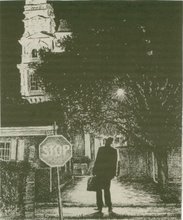
Monday, March 19, 2012

Jack Kerouac Comes to Gloucester


So far as I’ve been able to learn, Jack Kerouac came to Gloucester only once. Charles Olson told me the story, for it was Olson, the poet, that novelist Kerouac paid a call to one night in late October of 1968.
There was much talk of Kerouac that fall. Jack had just published what would be his last full-length novel, the haunting Vanity of Duluoz, which picked up the story of his life—he preferred to call it “the legend of Duluoz” and compared himself to Marcel Proust, claiming that his own work comprised “one vast book like Proust’s, except that my remembrances are written on the run instead of afterwards in a sick bed”—from the years between his football star days at Lowell High School and his even briefer stint as a scholarship student and football whiz kid at Columbia College under coach Lou Little; and those spent roaming the country he’d already written about in his bestselling novel On the Road.
Harvey Brown, the publisher of Frontier Press books in West Newbury, had obtained an advance copy of Vanity of Duluoz, and had immediately gotten on the phone to read parts of it to Olson in Gloucester. Olson told me he was pleased Kerouac was again writing about what was closest to him, his origins and his life in Lowell—and he was doing it in Lowell, where he’d returned a few years before, at the age of 45, to marry Stella Sampas, the sister of his late best friend Sammy, and set up housekeeping again in a home he’d bought for his wife and his mother on Sanders Avenue, across the river from Pawtucketville, in the southwest part of Lowell. Olson also told me that he believed Kerouac was writing some of the most important prose in America.
Although Kerouac is best known for his “Beat” or “Road” novels, books like On the Road, The Subterraneans, The Dharma Bums, Big Sur and Desolate Angels, which constitute a prose chronicle of the lives of some members of what the Media, after Kerouac, had come to call “The Beat Generation,” his biographer Ann Charters reports that his own books which were dearest to him were all set in Lowell, Massachusetts, the city of textile mills on the banks of the Merrimack River.
Since Kerouac’s death more attention has come to be focused on the Lowell novels, Visions of Gerard, Doctor Sax and Maggie Cassidy. And it is to these books that I would call the attention of new readers of Kerouac; for I know of few books in American literature where what it feels like to grew up in a small town or city in the 1930s and 40s, among an immigrant population, in working class neighborhoods, is as accurately and movingly rendered, as Kerouac has managed to do, particularly in a manner that differs radically from previous native writing.
Rather than the usual American realism or naturalism, in the Lowell novels you have instead a Proustian sense of the recapturing of lost time, often the most delicate sensation of how the intermingling of memory and dream, intuition and recollection, gives a deeper and far more penetrating vision of a time, place, person or thing than any cinematic or purely photographic depiction. As far back as the 1940s, Kerouac had a deadly serious notion about the kind of writer he wanted to become, telling his father, Ann Charters writes, that he planned “a lifetime of writing about what I’d seen with my own eyes, told in my own words. . .and put it all together as a contemporary record for future times to see what really happened and what people really thought.”
Doctor Sax recounts the story of a young man’s coming of age, his loss of innocence and his initiation into the mysteries of good and evil, death and rebirth, against a symbolic backdrop of Depression-era Lowell and the Great Flood of 1936. Maggie Cassidy, is a tender, almost wistful recollection of a high school romance. In both, it is not only the actual events that Kerouac’s prose recreates and enacts, but also the atmosphere surrounding them—including the slang that was spoken, the songs sung, the radio programs listened to, the magazines read and the products consumed—animating them as they filter through the consciousness of his narrator-protagonist. “The whole thing,” as Kerouac wrote, “seen through the eyes of poor Ti Jean (me), otherwise known as Jack Duluoz, the world of raging action and folly and also of gentle sweetness, seen through the keyhole of his eye.”
To get back to Olson’s—and my—story, I’d gone over to Charles’s at 28 Fort Square a couple of days after the Kerouac visit to help him celebrate the publication of a major book of his own, the second volume of The Maximus Poems, which had just been released by Cape Goliard Press in London. The first thing Olson said to me after I told him I’d been up all night reading the new “Maxies,” as he called his Gloucester epic, was “You missed your man.”
 
“What?”
“Kerouac was here.”
“Jack came to Gloucester and I missed him?”
“That’s right.”
I was crushed, and disappointed, for I’d long wanted to tell Kerouac in person just how much his books meant to me. Harvey Brown and I had talked about going to visit him in Lowell, but Kerouac had moved yet again before we could act on our plan. To console me—and also because he relished telling it—0lson told me the story of the visit.
He’d been in his kitchen. It was a mild October evening and he had either the windows or the kitchen door open. He heard someone calling his name—“Olson! Charles Olson!”—in a kind of drunken singsong voice. He went to the door, stepped out upon that back porch from which you could see the whole city of Gloucester, eerily that night under the spell cast by the mercury vapor street lamps the poet so hated—“they destroy the color of color in human faces,” he had written his “Scream to the Editor” of the Gloucester Times.
Olson made out three figures in the gloom at the foot of the long staircase to his second floor apartment, and the one who’d called his name was now shouting, “The red carpet treatment. I expect the red carpet!”
Olson immediately recognized Jack Kerouac (whether or not they’d ever met before he never told me), disappeared into his kitchen and returned with the first thing he’d grabbed, which turned out to be some pages from the Boston Globe’s Sunday magazine section. Down the steps the massive poet plunged, and he slipped the pages under Kerouac’s knees, while the novelist proceeded to negotiate the stairway on hands and knees, Olson alternatingly removing the paper and slipping it back under Kerouac’s knees, until they’d made their way laboriously to the top of the stairs and across the porch to Olson’s kitchen door, whereupon Kerouac entered, slumped down into a kitchen chair and asked for a drink.
I can’t remember Charles telling me what they talked about, or if they ever did talk. At some point Kerouac, who was already drunk (he’d written earlier that year in Vanity of Duluoz, “If I myself, for instance, were to try to follow Jesus’ example I’d have first to give up my kind of drinking, which prevents me from thinking too much, like I’m doing now in awful pain this morning, and so I’d go insane and go on public debt and be a pain to everybody in the blessed ‘community’ or ‘society.’ And I’d be furthermore bored to death. . .”) either passed out or was assisted back to the car by the two men who had come with him. They turned out to be his Greek-American brothers-in-law from Lowell; and Olson, who knew a slew of Greeks between Gloucester and Washington, D.C., reported spending the rest of the night absorbed in animated discussion with them, while Jack slept off his liquor downstairs in the car.
It wasn’t until long after the Kerouac caravan had set off for Lowell that Olson noticed the Boston Globe magazine pages he’d red-carpeted Kerouac with lying on the floor of his kitchen, and, picking them up idly, found that Kerouac had come up Olson’s steps on hands and knees pressing down upon the very article that Kerouac himself had just written. In it, Kerouac, who had for ten years been trying to get rid of the “Beat Generation” label, which he felt had kept his books from the serious critical attention accorded other writers whose books weren’t nearly as innovative and truthful as he believed his to be, disavowed any kinship with the current generation of “Hippies” and student rebels, he, as an “Apostle of the Beat,” had been accused by the Media of fathering. He had—prophetically—entitled his article “After Me, the Deluge,” but the magazine editors had re-titled it, “I’m a Bippy in the Middle.” The compound irony hit home for many of us.
Shortly after his visit to Olson, Kerouac moved from Lowell to St. Petersburg, Florida so that his ailing mother could be in a warmer climate. A year later he was dead, as the newspapers reported, “of a massive gastric hemorrhage,” and his wife Stella insisted, of loneliness.
Two months later Olson died, in New York Hospital, of cancer of the liver. Both men died away from the places that had nourished and sustained them, and which figured centrally in their works as well as in their lives.
Allen Ginsburg spoke to friends at Olson’s funeral in Gloucester of a sense of “an ending of something,” and of an uncanny feeling he’d had of having come almost directly from burying Kerouac in Lowell to inter Olson in Gloucester, though the two funerals were about two and a half months apart. Later, in an “Eclogue,” he wrote: “Kerouac...Olson, ash and earth.”
And many of us did have a sense then, under the terrible strain of those Vietnam years, of an ending of something, of a dream maybe, a promise, that we all had, of a possibility, an idea of America, which Kerouac and Olson, each in his own way, had reminded us of; had, in their work and in their visions, held us and our country to.
I went home from Olson’s funeral to write in my journal:
“And now it seems I am back where I began. The two American writers I most loved and respected are dead: Olson of cancer, Kerouac of drink. With their deaths a force seems to have gone out of my own life, a pungency from the very air of New England. Reading Doctor Sax and Maggie Cassidy, Kerouac’s two neglected Lowell novels, had freed me of the old prose stance and taught me the possibilities of a lyric repossession of the authentic past, while Olson pointed me into the future with the tool of mythology as epistemology not art-form, and the fix of self.
“It was a good feeling to sit up here on Thomas Riggs’ hill in Riverdale, knowing that Charles was down in his house at the Fort overlooking the harbor and that Jack might well have been working away in his bedroom in Lowell not far from the woods where Thoreau had lived and walked. I often thought of us as ‘spies of all the gods,’ in Allen Ginsberg’s phrase, a kind of Massachusetts brotherhood of the Craft, though we were never together in the same room and I never did get to meet Jack.”
(This is the text of a talk I gave on March 12, 2012 at the Gloucester Writers Center, to celebrate Kerouac's 90th birthday.)

Sunday, February 19, 2012

Peter W. Denzer, 1921-2012


I, too, forget

and over years

learned the grammar

of daily ruckus.

Growing deaf to the racket

of our time,

I now hear voices

of leaves and stones and stars.

-Peter Denzer

Peter Denzer and I first met in Brunswick, Maine during the fall of 1957. I was a junior at Bowdoin College and an aspiring writer; Peter had just published his third novel, The Last Hero. He and his then wife, Ann Sayre Wiseman, a painter, writer and illustrator of children’s books, lived in an airy flat in a 19th century redbrick apartment building, a block from the Cabot Mill and the Androscoggin River, which had once been the abandoned factory’s principal source of power. You could hear the roar of the river from the Denzer’s front living room.

Up each morning at first light, Peter was at that time working on his fourth novel, The Diggers, a narrative of hardscrabble life on the coast of Maine, to which Peter and Ann had moved the previous spring from New York’s Greenwich Village. In a study not much bigger than a closet, he wrote until noon on a big green manual typewriter set on a wooden packing crate. After lunch with his family, Peter would leave the apartment and stroll down Maine Street to Fairfield’s Book Shop, directly across from the Bowdoin campus, where from 1 p.m. until closing time he was the manager, eventually transforming an already popular and well-stocked book store into the town’s principal intellectual and artistic meeting place.

Besides working at Fairfield’s, Peter wrote a couple of “potboilers” and a series of magazine articles to make ends meet. He also broadcast a noontime weekly radio talk and interview show from the Harriet Beecher Stowe House, the town’s premiere restaurant and inn. When Grove Press published the first unexpurgated American edition of D. H. Lawrence’s Lady Chatterly’s Lover, in 1959, Peter invited me to discuss it with him on the air. I needn’t report on the wave of outraged comments the Bath-Brunswick radio station owners were inundated with in tight-laced Maine!

Tall, handsome and Hemingway-bearded, Peter was the kind of writer I and my literary friends on campus hoped to become. Though his first three novels had been well received (all were favorably reviewed in the New York Times, the Washington Post and the San Francisco Chronicle), we admired his honesty about having to make a living in the real world; and we were especially attracted to his savvy regarding agents and publishers and his progressive politics, both an antidote to what we were getting from teachers whom the McCarthy Era had made gun-shy about sharing their own ambitions and beliefs.

Born in 1921 in New York, to a Jewish physician father and an Irish mother from the Mid-West, Peter grew up in the city. He attended public and private schools and entered Oberlin, where he met novelist and conservationist Louis Bromfield, who wrote books and farmed, occupations that Peter would later combine, first on a 100-acre farm he bought with the help of a G. I. Loan, in 1959, in Richmond, Maine, and later with his wife Mary, in Houston, Minnesota. Bromfield proved to be an early influence on Peter’s life-long ecological ethos.

Leaving Oberlin in 1939, Peter worked as a farm and factory laborer, experiences that he would later make use of in The Last Hero. He attended Syracuse University before serving in the U. S. Army Medical Corps until 1941. After military service, Peter embarked on a career in journalism, beginning as a Washington correspondent for Transradio Press, United Press International and Broadcasting Magazine, where he covered all beats, including The White House, Congress and the Supreme Court. Peter also contributed articles and reportage to the progressive New York daily newspaper PM.

In 1945, as a result of his journalistic experience and his command of German, Peter served as a political advisor to the staff of Ambassador Robert P. Murphy at Supreme Headquarters Allied Expeditionary Force (SHAEF), in Germany. Following that appointment, he became director of the American News Service, in Vienna, and editor and publisher of The Daily American, the first privately published, independent English language daily newspaper in post-war Germany. Before leaving Europe in 1950 to return to the United States, Peter also served as director of Stuttgart Studio AFN, in Germany. Peter was one of the first journalists to enter Dachau after it was liberated by the Allies and he never forgot what he saw there.

Upon his return home, Peter continued his career in broadcast journalism, first at WWJ in Detroit, where he produced the radio documentary “Listen Detroit,” and then as news director at WPAC-Ann Arbor and WRIT-Milwaukee. During these years Peter was married to the late journalist and TV producer Beryl Schoenfield, and they had two sons, Peter and James.

In 1954, Peter’s first novel, Episode, the story of a young soldier’s struggle with mental illness, was published by E. P. Dutton. It was followed the next year by Find the Dreamer Guilty, also published by Dutton, about two teenage boys involved in a sensational murder. By this time Peter’s desire was to devote himself entirely to writing. Returning to New York in1956, he lived in the Village and Long Island while working on The Last Hero, a searing coming-of-age novel set in Upstate New York, published in 1957 by Henry Holt and Company. A visit to friends in Robinhood, Maine led to a meeting with renowned sculptor, William Zorach, which rekindled a childhood wish to work in wood, stone and clay that would not be fully realized until Peter moved to Italy in 1960. That visit also inspired Peter to leave the city for what he hoped would be a simpler and less expensive life in Maine.

After graduating from Bowdoin in 1959, I moved to Florence, Italy to study Medieval Literature at the university. A year later, Peter, his wife, and sons Piet and Kiko, joined me so that Peter could research and write a novel based on the life of poet Ezra Pound, who had lived for many years in exile in Italy. We shared a small villa in the Tuscan hillside village of Settignano, where Peter completed “The Alien” and I finished my own first novel. In 1962, I returned to America, but Peter remained in Florence, where he met the American artist Mary Alexandra Milton—“Maria”—who would become his wife.

Living in an ancient palace, on Via dei Rustici in the heart of Florence, Peter and Maria shared a remarkable life. Continuing to write and publish, Peter also carved from the native stone and modeled in clay, while Maria produced paintings, drawings and sculpture. In 1969, the couple returned first to New York, where they worked in publishing, and then to Maria's native St. Paul, where Maria was apprenticed to the potter R. Broderson, later teaching Peter the art of throwing and glazing. On Grand Avenue, in St. Paul, Peter and Maria founded Front Porch Pottery and Gallery, where they exhibited and sold their own pottery, subsequently relocating their workshop to the farming community of Houston, where they continued to live self-sufficiently while participating in the life of the community.

Known after his career in journalism primarily as a writer of fiction and essays, Peter had also made a reputation as a poet, publishing poetry in anthologies and literary journals. Poetry, however, was not a second art for Peter, something he’d done with the left hand while writing fiction with the other. From an early age Peter had written poetry in parallel with fiction and essays, each genre inspiring and influencing the other. When I first knew Peter, he would read his poetry to a group of us after dinner in that art-filled apartment on Maine Street, in Brunswick. And later, when we corresponded for many years (I shouldn’t forget Peter’s brilliant, informative and witty letters as yet another of his literary accomplishments), Peter would always share his latest poems.

Peter’s poems are often the compact statements of what he would dramatize in fiction or write critically about in essays and letters. They are at once personal and political, lyrical and didactic. What he felt he couldn’t express in prose he found words, images and metaphors for in poetry, in a voice that is equally as strong and distinctive as his prose voice. Peter’s journalism, which brought him into immediate contact with the world and its workings, informed the powerful realism of his fiction, just as his work in each of those genres informed his poetry. But the poetry is where this man, who was both passionate and rational, went to feel—to express what he couldn’t say in prose. In the end, all of Peter Denzer—his passion, his rationality, his political commitment, and his love for an endangered earth and all its creatures—can be found in the poetry. The poetry is the synthesis of his life and work, a cry, as Peter has written, "against ugliness imposed on the planet’s fragile life system by war, greed, and ego unhinged by fear and the mystery of beginnings and endings.”

Peter, who had been suffering from the effects of Parkinson’s disease, died at the age of ninety of congestive heart failure, on Monday, February 13, 2012, at the Valley View Healthcare and Rehabilitation Center, in Houston, Minnesota. Maria, his beloved wife of nearly 48 years, was at his side. Before his death, Peter completed his final book, a memoir on which he had been working for several years. This essay will be part of an introduction to Peter's memoir to which I and other friends have been asked to contribute.

Saturday, July 2, 2011

Hemingway's Death Fifty Years Later


I can remember exactly what I was doing fifty years ago today, on July 2, 1961. I was walking through Piazza del Duomo, one of the main squares in Florence, Italy, on a hot early summer morning when I saw the headline on a newsstand: `E MORTO HEMINGWAY. He was one of my heroes, as the recently deceased Albert Camus had also been, and I stood there frozen in front of the headline. As soon as they noticed it, the people in the piazza around me paused in silence. Those who wore hats took them off; others bowed their heads and crossed themselves. Italians considered Hemingway one of their own. He had been awarded medals for his service on the Italian front in WWI and they loved his novels and stories, especially those with Italian settings.
I was twenty-three years old. I had been living in Florence since the fall of 1959, studying Medieval literature at the University and teaching English at the International Academy, a private school for high school graduates and college students, who wished to pursue careers in diplomacy. Writers like Hemingway and Camus, whose classically paired down French prose was influenced by Hemingway’s, were very important to me as a budding writer. I had already completed my first novel, set in Greece, and I was working on a second, set in Florence, involving a love affair gone awry between a young expatriate couple.
I had been reading Hemingway since ninth grade. There were passages in The Sun Also Rises and A Farewell to Arms, as well as from some of his stories like “In Another Country” and “A Clean, Well-lighted Place,” that I knew by heart. The Hemingway who had inspired me to write was not Hemingway the big-game hunter or Hemingway the adventurer of later years. It was the early Hemingway, the young writer, who had learned his craft in 1920s Paris, surrounded and influenced by important avant-garde writers like Gertrude Stein, James Joyce and Ezra Pound. I had gone to Europe not so much to study literature as to imbibe the cultural, artistic and intellectual atmosphere that had nurtured the Lost Generation of writers and artists I admired as an undergraduate, reading everything I could find about their lives and their work habits. I chose Florence not Paris because I also wanted to study the poetry of Dante and his contemporaries on the very ground of its creation, in the original language.
Still, I had followed Hemingway’s later life in newspapers and magazines. I continued to read his more recent novels and stories, and I had been thinking of him a great deal as I devoured the novels and stories of the late Cesare Pavese, an Italian writer, who was much influenced by Hemingway’s style and sensibility, and who had committed suicide himself in 1950.
I can’t imagine what sort of impact the death of a master like Hemingway might have on an impressionable young writer today, although I’m aware of how the recent death of the incredibly gifted young novelist and philosopher David Foster Wallace had on many writers of his generation. Though I had not read a lot of Wallace before he died, I, too, was devastated by the news of his suicide, saddened as I also was about the promising life that was cut short.
When Hemingway’s death was first announced, it was suggested that it might have been accidental, that the shotgun that had killed him had gone off when he was cleaning it. But those of us who knew Hemingway through all his novels and stories , though we might not have known much about the depression he suffered in the years leading up to his death, or the terrible bouts of paranoia that his later biographers described, knew, or intuited, that he had ended his own life. His suicide was the stoical act of a Hemingway hero, a man who had pushed himself to the limits of human endurance and, in the process, had understood that when something was over—a love affair, a battle, a life—it was over. Given his depression, exacerbated, as we later learned, by an array of physical and psychological symptoms, not to speak of alcoholism, it could not have been easy for Hemingway that he seemed no longer able to write. Nor that he had been forced to leave Finca Vigia, his great home and refuge in Cuba since the 1940s, and was, at the time of his death, an exile in his native country, while also under surveillance by the FBI. (See today's New York Times op-ed page for a column by Hemingway's friend and collaborator, A. E. Hotchner, which corroborates the FBI surveillance).
After his death, Hemingway’s art was subjected to the critical eye of feminism, an important and perhaps even necessary reappraisal, though today some of the most astute and sympathetic critics and scholars of Hemingway are women like Rose Marie Burwell, Hilary K. Justice, Jacqueline Tavernier-Courbin and Debra Moddelmog. Nevertheless, his finest biographer, in my view, is Gloucester native James R. Mellow, whose Hemingway: A Life without Consequences is the benchmark against which all future biographical and scholarly work on Hemingway must be measured.
There was much that Hemingway taught us, we young writers, who dreamed of living and writing as he had. He showed us what a perfect sentence looked like and how feelings could be reflected by the things we described or that our character’s encountered. He helped us to understand the importance of place and the equally important precept that you did not need to say more than was necessary to set a scene or describe a character. Indeed, his greatest contribution lay in his teaching that what lay under the surface of things had as much or more dramatic impact as what one could immediately observe or report, and the writer's responsibility was to suggest it not tell it.
On this blog, on July 22, 2009, I posted my own appraisal of Hemingway on the occasion of the publication of a revised edition of A Movable Feast, Hemingway’s masterful sketches of his early years in Paris. "Hemingway Revisited" can be read at http://peteranastas.blogspot.com/2009/07/hemingway-revisited.html While neither complete nor definitive, it is my tribute to a very great writer whose work will live as long as we have literature and whose death, fifty years ago today, I remember with equal sadness.

Thursday, May 12, 2011

"Townie," by Andre Dubus III: A Review


Townie, Andre Dubus III, W.W. Norton & Co., pp.387, $25.95

Andre Dubus III, age 16, was walking through the student union building at Bradford College, in Bradford, MA, where his father, famed short-story writer, Andre Dubus, Jr., taught English and creative writing. Though it had recently admitted men, Bradford, was primarily known as a women’s college.

“So many of them were tall and slim,” the younger Dubus recalls many years later in Townie, his riveting memoir of coming of age in the dying industrial cities along the Merrimack River. “They had long straight hair and straight teeth and straight postures from what I imagined were childhoods spent riding horses and swimming and playing tennis.”

As he made his way to class that day in the early 1970s, a group of these students stood near a picture window that looked out over the well-tended green lawns of the college.

“That’s Dubus’s son,” he overheard one of the young women commenting to her friends: “Look at him. He’s such a townie.”

Though his famous father is dead and Bradford College has closed its doors, Dubus, now the highly acclaimed author of novels like House of Sand and Fog, cannot forget that slur.

“I’d heard it before,” he writes. “They’d used it for the men they’d see at Ronnie D’s bar…plumbers and electricians and millworkers.” Though not yet 18, Dubus was already a full-time college student.

“I enjoyed reading the books,” he writes, “but I was surrounded by people who seemed reared from comfort, most of whom knew where they were headed.” These privileged students all appeared to have aims for the future. “But I didn’t have any,” Dubus admits. “All I wanted to do was bench press 300 pounds and get so big I scared people, bad people, people who could hurt you.”

Townie is the gripping story of what led the son of a professor, who lived in the secluded comfort of a suburban college community, while his former wife and four children endured poverty across the river in working-class Haverhill, to seek strength and self-worth in body building. It’s the account of how a small boy who was bullied became a defender of himself and his siblings in a city where “kids roamed the neighborhood like dogs,” and teen-age girls “just gave it away.”

But this painfully honest memoir isn’t only the story of how a boy who grew up on the mean streets of Haverhill became an accomplished writer; or about how the way he learned to defend himself as a street fighter and trained boxer became both a salvation and potential damnation. It is, most urgently, about how Andre Dubus learned to transform the pain and violence that led him to become that fighter into words, which ultimately saved him. Townie, in all the immediacy of Dubus’s compelling narrative, is at its core a book about the paradoxically redemptive power of violence.

Dubus’s prose, and the distinctive voice it embodies, is the hard-won achievement of the author of three novels and a collection of stories. Its stunning tensions also reflect his father’s precision in matters of the heart, along with Jack Kerouac’s haunting descriptions of the streets of Lowell, so much like those Dubus himself lived and fought on in Newburyport and Haverhill.

Townie is more than a fine memoir. It is the record of a quintessential American life. Its bravura ending, tying together all the disparate strands of an often harrowing childhood and adolescence, is one that only a skilful novelist like Andre Dubus III could have achieved.

“Just go ahead and write,” his father once counseled him. And Dubus has done precisely that—brilliantly.

(This review appeared in the May 2011 "Literary Madness" issue of North Shore Art Throb.)

Thursday, March 24, 2011

Why I Self-Published Decline of Fishes


There has always been a certain stigma attached to self-publication. When a writer decides to bring out his own book, the unstated but ever present question is: “Why couldn’t you find a publisher?” By a publisher, the asker of such a question usually means a conventional trade publisher. A subsequent, if hidden, assumption is, “If you couldn’t find a publisher—or an agent to represent the book—it can’t be a very good one.” This is the nub of the problem for writers who do not have an agent or who have not published with a major trade publisher.

After I completed a first draft of my novel, Decline of Fishes, I thought about querying agents. I also thought about the current state of the literary market and whether my book would fit into any of the categories—or niches— for commercially marketable books. Each week I read the major book review publications, I visit bookstores, and I scan the “new books” shelves in public libraries, so I have a pretty good idea of what’s being published and who’s publishing it.

Consequently, I asked myself if my novel conformed to any of those categories or if my personal and literary profile matches that of any of the writers currently being published. Aside from the masters like Philip Roth and Thomas Pyncheon, who have their own loyal readerships, or the dwindling number of mid-list writers who remain in print, my work seems to have little in common with that of younger urban-based writers who are publishing today. Surely it has none of the exoticism of post-colonial writing or the linguistic experimentation of recent European immigrants. I don’t write about ethnic subcultures, or about the challenges of contemporary marriage and child rearing. Neither do I write about divorce and the single parent life or the demands on young professionals of corporate culture, so why would an agent be interested in representing me?

Even if I were to find an agent, how long would it take to place my book? And once placed, would it be subject to the kinds of violations a number of writer friends have recently had their fiction and non-fiction subjected to in the editorial process? In other words, would the wait—a long and probably fruitless one—be worth the effort, especially at my age and considering that the subject of my novel—the pressure on traditional cities and towns like Gloucester, Massachusetts to sell out to developers, thereby undermining their indigenous character and culture—is of moment.

On its face, my novel about a group of local activists who oppose the construction of an upscale shopping mall on the city’s working waterfront, just as the fishing industry faces its greatest crisis, sounds like a story that might attract interest. It’s relevant—how many American communities are fighting to preserve the traditional culture and economies of downtowns forced to compete with Wal-Mart or Big Box shopping malls? It’s accessibly written in direct and realistic prose. It has what I have been told are believable characters, who struggle with personal conflicts and a threatened way of life as they fight the mall’s developers. The plot is suspenseful—what kinds of power and money lie behind the attempt to develop the mall? And there is a dramatic payoff. Will the developers get their way? Will the main characters resolve their conflicts; and who will benefit or lose from the final outcome?

I shared my concerns about finding an agent or an appropriate publisher with several writer friends, each of whom had experienced some form of the interventions I have described in the agenting or publication process. One friend had 150 pages cut from her original manuscript and was required to rewrite the book from a more marketable perspective, thereby violating her original intent. Given these concerns and our shared sense of the exigency of my subject, my friends urged me to bring the book out myself.

Five writer friends—one a former senior editor at a prestigious Boston publishing house, another the editor of a national magazine, all of whom have published fiction and non-fiction in major venues—have read and commented upon my book through several revisions. Their comments, criticism and suggestions have helped to shape, sharpen and improve the novel. Considering their experience, I feel that Decline of Fishes has received as much if not more editorial scrutiny than it would have received from a trade publisher. And the book has not been compromised to fit a commercial interest or market.

Fortunately, a local alternative to mainstream publishing already existed. Believing that writers themselves should have ultimate control over the content, editing, design, promotion and distribution of their books, poet and playwright Schuyler Hoffman and I founded the Back Shore Writers Collaborative in 2005. To date we have published two books under the imprint of Back Shore Press, Peter’s Tuttle’s road poem, Looking for a Sign in the West, and my novel, No Fortunes, both of which have been well received and reviewed. We have worked with local artists and designers and regional printing facilities to produce our books and we distribute and sell them through independent booksellers and the Internet.

Along with the incredible support of Janice Severance, owner of the Book Store of Gloucester, two thoughtful and positive reviews (see below) and several local news articles and interviews have helped to launch Decline of Fishes. In the coming months I hope to be doing more public readings. But what has encouraged me the most are the personal communications from friends and readers, who have taken the time to write or email me their responses to my novel. Their helpful and insightful comments have made the years I spent researching and writing this book, often with scant hope of publication, seem worthwhile. I extend to them my deepest gratitude.

Wednesday, December 1, 2010

Decline of Fishes: Review by Alex Miller


Peter Anastas, a member of the generation of Gloucester writers influenced by Charles Olson, is by now a familiar figure for attentive readers on the North Shore. Having adopted Olson’s pattern as a writer-plus-activist, Anastas has made a career out of hearty involvement with his own place. His emphatic view is that, for an author of his disposition, citizenship and art must grow through and out of one another-hence his dual role in Gloucester as a writer and, at various stages, a social worker, a protester, a teacher at community colleges, and a sitter on numerous committees. Now in the mature flowering of his career, and more hounded than ever by questions of responsibility toward his endangered home landscape, he has released what he refers to as “the most personal book I have written.” Decline of Fishes, whose Greek-American-writer character Jason Makrides bares a massive resemblance to Anastas, is an arresting work of storytelling, which functions as a crash course in local politics and economics while managing to be neither preachy nor fact-clogged.

Set in 1993, Decline of Fishes narrates the struggle of several Gloucester residents to resist the building of a mall on the city’s waterfront; a project which, according to local regulations, is prohibited due to the fact that it depletes the docking and loading space available to working fishermen. Additionally, the mall is seen by many Gloucesterites, including Jason Makrides, a social worker and former novelist, Allison, the intelligent wife of a local pro-mall development committee member, who is having an affair with Makrides, Nina Calogero, a tenacious fisherman’s wife, and Frank Acciaio, an aged and wise sculptor and connoisseur of local flavor, as nothing less than a stain on the city’s “soul”: an exploitative and trivializing project that will poison Gloucester’s home-grown industry while inviting more rich out-of-towners to come in, build condos and luxury boutiques, and speed up a destructive process of gentrification. Though much of the novel’s action takes place in committee rooms, restaurants, and around kitchen tables, where those resistant to the mall discuss its implications for the city and strategize about how to defeat the development committee’s request for special permission to build on property reserved for the fishing industry, the lives and struggles of the characters remains its focus, and as a result, it flows smoothly and remains, perhaps surprisingly, a page-turner.

Gloucester, like many communities, is really struggling to define itself-and hang onto itself,” says Anastas. “I am an activist; I have lived through this struggle, and I wanted to participate in any conversation that would help people understand how real this place is.” In Decline of Fishes, he has certainly done this. By the time we are ushered into the meeting where the mall will at last be voted up or down, the tension is wound harrowingly high. But the tension of Allison and Makrides’ Romeo-and-Juliet affair, which breaches warring clans, and of the Gloucester Daily Times reporter Lori Lambert’s internal struggle to reconcile painful memories of an abusive fisherman-father with increasing sympathies for the fishing families who would suffer an economic body-blow from the mall’s presence, is just as involving. Decline of Fishes proves to be as much about the inner lives of its major characters as it is about the eco-cultural life of a city. In fact, the implication is that these two aspects are, ultimately, synonymous.

--Alex Miller

Decline of Fishes
By Peter Anastas,
Back Shore Press, 382 pp., $18.95

(This review appeared in the November 29, 2010 online edition of North Shore Art Throb)


Sunday, November 21, 2010

Decline of Fishes: Reviewed by Rae Francoeur


“Decline of Fishes” By Peter Anastas. Back Shore Press, Gloucester, 2010. 382 pages. $18.95.

The view from your window matters.

Jason Makrides, the protagonist in Peter Anastas’s beautiful and thought-provoking new novel, “Decline of Fishes,” gazes upon Gloucester, Mass., the venerable but troubled fishing town he loves. Gloucester appears to him like a painting of Venice by Canaletto, rising in radiant sunlight.

In a moment of solemn reverie he takes in the city’s special, endangered beauty — as lovely as it is sad. “I saw fishing vessels making into port, trailed by gulls. I saw the shining Birdseye tower and seawalls along the Boulevard holding everything in against the power of the ocean. Gloucester, I thought, Glowing City….” Readers must complete this passage on their own to understand the significance of this concluding meditation.

In “Decline of Fishes,” the last empty waterfront parcel becomes the focus of a heated citywide debate between developers and the imperiled fishing enterprise. The parcel pits those who see a proposed new mall as a way to bolster the flagging tax base against those who want to hold on to Gloucester’s unique culture. It examines the difficulties of choosing between promising profitability and preservation of existing businesses subsisting on meager profits.

Simply put, the book tracks the divided community’s preparations for the City Council debate up to and including their final vote on the mall’s future. Or is it Gloucester’s very identity as a fishing community they are deciding here? The focus is less on the immediate drama — neighbor vs. neighbor — and more on the far-reaching consequences having to do with community, values and economy. A man does wield a rifle, the automatic response, in some cases, to oppressive conflict. In this book, though, discussion prevails over violence.

The parcel, remarkably, is smack in the middle of the fishermen’s working waterfront. Is this symbol or just good storytelling? Neither. In real life, such a parcel exists. If you take that empty lot away from Gloucester’s fishermen, what will follow but condos and yachts and the demise of a sacred, centuries-old way of life?

Among the key players in this story are the mall developer Win Guest, originally from Gloucester, and project’s lead attorney Jock O’Hanley. They want to build a mall with 25 stores, two restaurants and a 200-car underground garage. Their backing, though impossible to pin down, includes leaders in Boston politics, the Catholic Church and other outside special interest groups.

Lori Lambert follows the story for the local paper. The daughter of an abusive fisherman, she counters any possible sentimentality readers may conjure about the fishermen and their plight. Her life is a struggle still. Her marriage is on the rocks but she managed to get an education and a job at the newspaper. Still, the publisher is pro-development and the tendency is to quash findings that endanger the mall’s chances.

Among Lori’s mentors is Jimmy, the paper’s editor. Brilliant and community oriented, his days are numbered because the local paper is about to sell to outsiders. Lori’s other mentors include Jason and his friend and a fellow intellect named Frank. Nina Calogero, the president of Save Our Fishermen and a lively, articulate, committed wife of an Italian fisherman, is a natural-born organizer who makes delicious espresso and biscotti. When the battle begins to coalesce, she’s right there to help rally and organize. Allison is an attractive mother and teacher currently taking time off to raise her children. Her husband Dennis, a successful local builder in a position of power, has grown away from Allison. Allison and Jason conduct a passionate sexual liaison resulting in affection, self-examination and change.

This carefully constructed, layered book, so tightly focused in on Gloucester, is nonetheless a book of universal importance, especially in our country at this moment in time. Though a study on the deliberation of economic investment, growth and a community’s decision-making, “Decline of Fishes” is at its core a book about passions — intellectual and physical and entrepreneurial — and our attendant responsibilities. How do we function and choose, given these powerful, complex, at times warring drives?

Anastas, author of several works of fiction and nonfiction, is also a respected expert on the works and life of the poet Charles Olson. In “Decline of Fishes” he explores, with care and precision, a number of timely themes.

First, of course, is the future of this city that’s still, by most comparisons, as unique an “island” culture as any in existence. And there is, indeed, a last undeveloped parcel that was the source of contention in the 1980s. Now its disposition is a bit more resolved, with half the property reserved for maritime use. At the current time, this vacant parcel, called I-4, C-2, is under “idea development.”

Another resonant issue is the empowerment and importance of women. Allison, Lori and her less fortunate sister, as well as the fishermen’s wives take on vibrant heartening roles via Anastas’s pen.

My own favorite theme is the deeply explored meditation on reading, writing and study. In Gloucester’s world of fishermen and poets — and unique and fully realized characters — books are as significant as the fishery. In this city there are bookshelves crammed with books. Books, though possibly as imperiled as fishes, are here key to man’s most passionate of all endeavors — the search for self and meaning.

Writing, too, emerges as a significant theme. Jason is the writer who suffers tremendous unhappiness when he tried to merge his writing life with his family life. Unable to resolve the conflicts, he puts his writing aside.

For now, there’s enough of Gloucester’s unique personality to celebrate and debate. Yet those who read the development attorney’s dire warning at the end of the book will know what he’s saying. The “Decline of Fishes” takes place in the past — when the fishery was larger and more viable.

The view today, though stunning and reminiscent, is not quite the same.

This review appeared in the Cape Ann Beacon, on November 17, 2010. Rae Francoeur can be reached at rae.francoeur@verizon.net. Read her blog atfreefallrae.blogspot.com or her book, “Free Fall: A Late-in-Life Love Affair,” available online or in bookstores.