Tuesday, June 11, 2013

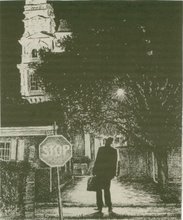
Brian James reviews A Walker in the City: Elegy for Gloucester for North Shore Art Throb


A Walker in the City

Gloucester rises dramatically, unevenly from the harbor. Jagged sets of houses grin from the hillsides, a whole city keeping eyes on the giving sea, the taking sea. This is the city that I can see out the window, hazed in a blue fog, as I sit semi-circled with the devotees of the Gloucester Writer’s Center. And while I, so clearly an outsider, am enamored of the physical city, of the dense mystery, the natives who huddle here are not interested in the view. They wait, instead, for the raising of a spirit, over there, where a stool sits spotlighted.

Peter Anastas - Photo Courtesy of Mike Dean/Gloucester Daily Times
Peter Anastas is the conjurer of the evening, reading from his new collection of editorials, A Walker in the City: Elegy for Gloucester. This elegy does, indeed, mourn a lost age, but it also reawakens the spirit of the past, or the imagined past, that each listener so proudly and intensely possesses. As I watch Anastas, the poised storyteller with a voice and gesture that bespeak the familiarity of his audience, I also can’t help but survey the audience itself, all feeders, made strong with memory. They wade through his words, waiting for resonance, and when they find it, they rise in their chairs, they laugh, they eye each other, probing for shared satisfaction. Is this our Gloucester? It is our Gloucester! Isn’t it?

Having written of the city over decades of change (the articles were published in Gloucester Daily Times and North Shore North from 1978 to 1990, and range back in subject to life in the 1950s), Anastas’ Gloucester is consistently colorful, lively, and fragrant. His childhood memories, which are the focus of many articles, confirm the popular imagination of post-WWII America, a place of storybook color and definition:
The noise of carnivals, wafted across to us from Stage Fort Park on the freshening night breezes—those snatches of merry-go-round music, the sharp voices of the barkers urging you to bet on the wheel or take a shot at a doll for your girl…” Anastas indulges the fondest visions of the past, a time of cohesion, community, and innocence.
But even these brightest glimpses live in the shadow of Anastas’ most prevalent theme: loss. After descriptive reveries about working
with Papouli (Greek for grandfather) at his shoe repair shop, Anastas dials us back to current realities in jarring fashion: “Then Papouli retired and after that he walked with a cane and there were to be no more Saturdays at the shop, which remained empty before they tore it down.” At times, Anastas steps out of his largely narrative role to elucidate on the bigger picture of loss. One of his most eloquent reflections on the subject can be found in “Mourning Long Ago Landscapes”: “Robbed of things we remembered, we are also robbed of our histories; and we are, therefore, faced with a double mourning, as painful to undertake as it is puzzling to comprehend.”

Gloucester readers feel this “double mourning,” often relating it to the recent urban development that has reshaped the city and threatened a long-standing way of life. Anastas has also been a voice for this anger. A Walker in the City is divided into four sections, three of them largely picturesque and elegiac, one of them titled “Facing the Issues,” in which Anastas took on local government when education, environment, and local culture were threatened by outside forces and budget limitations. In these sections, the emphasis is always the same: preserve what has worked well, be careful moving forward, honor the city that we love. Despite his strong affinity for the past, Anastas pursues a “functional nostalgia rather than a regressive one.” In “Facing the Issues,” we see an active, present member of a community always in transition (but even his social action editorials are permeated by the romance of Gloucester past).

A Walker in the City reminds us how much we hunger for the articulation of our environment. Language shapes a city just as much as the landscape or architecture, and we want that spoken shape to be true, epic, and unique. What a tall and often contradictory order for the local writer. Give us a legacy! Make it great! Make it real! But Anastas is glad for such a demanding audience. This work has flowed from him without coercion or resentment. Perhaps this is because the demand from within Anastas is equally, if not more fiercely, demanding as that of the readership. His words are the only consolation, the only treasure store that remains after the wreckage of time has taken its irrevocable toll.

Brian James is an English teacher, a songwriter, and a church musician at HRNS. He grew up in Salem, lives in Salem, and writes about Salem, which is the setting of his novel-in-progress. Brian also collaborates with musician Jon Green, writing some lyrics and music. He is pursuing graduate studies at Salem State University.

Thursday, May 23, 2013

A Walker in the City: Elegy for Gloucester: A review by Rae Francoeur


NORTH SHORE BOOK NOTES: Peter Anastas' 'A Walker in the City'
By Rae Padilla Francoeur
Cape Ann Beacon
May 22, 2013

A Walker in the City: Elegy for Gloucester” By Peter Anastas. The book is published collectively by Lost & Found Elsewhere: The CUNY Poetics Document Initiative and Back Shore Press. 2013. 244 pages. $14.95

I am under the spell of Peter Anastas, who takes me by the hand in “A Walker in the City: Elegy for Gloucester,” and leads me to his grandmother’s stove to take a whiff of her wonderful keftedes, little Greek meatballs seasoned with onions, oregano and fresh mint. We walk to the Fort to watch men unload the fishing boats. We stroll to the library, through Dogtown at dusk, to summer camp to learn to swim. I see the summer gardens immortalized by John Sloan and I feel the restlessness of late August and I hear the quiet murmurings of a friendly neighborhood as the sun sets.

Anastas has compiled, in “A Walker in the City,” a collection of essays he first published in The Gloucester Daily Times and North Shore North in the 1970s, ’80s and early ’90s. This collection highlights Gloucester, not as an artifact of a past era, but as a community of souls arrived “on the brink.” Of what? Inevitable change, loss, annihilation of self? And how is this different from what Anastas faces as he grows toward his own unknown? The book is a layered and intimate conversation between author and reader.

Gloucester, in possession of unique and valuable resources, is a maritime-oriented community whose desire to retain its identity and way of life feels like a protracted and tragic struggle in these beautiful, heartbreaking essays. Gloucester is prey to developers who have won more than a foothold here. Will this one-of-a-kind city fall to a familiar default mode, one seen at so many seaside communities whose unique characters have been overwritten by hotels and shops and boardwalks?

Anastas begins with many eloquent reminiscences of his childhood, spent at the epicenter of what is still a captivating, dynamic community. In his urgency to capture the essence of his childhood and its symbiotic link to Gloucester, he manages to present a multi-sensory recreation of what we thought we’d lost — our youth. At the same time, he chronicles a community’s struggle for the survival of self. Sense of place, he writes, is the chemistry between particular people and a unique landscape. Change the landscape and change the people. Save Gloucester and save yourself.

I wonder, what is more alluring as subject matter — Gloucester’s years of struggle or Anastas’s? He’s self-aware, engaged in self-examination and somber even in his most eloquent and successful reincarnations of youth. Read the essays in Section I: This Side of the Cut and transport to a childhood so real that the buzz of a cell phone or even the honk of a car will seem surreally out of place. He may or may not mean to do this, but these beautiful evocations, so tinged with melancholy, are both warnings and, in a more hopeful bent, models. It doesn’t have to be too late. Anastas admits to his “perpetual condition of bereavement.” He carries a weight for all of us.

Roger Martin, poet in Rockport, once called Lura Hall Phillips “Rockport’s prod.” Phillips compelled people to work hard for the arts, for Rockport and for the betterment of the community. She wasn’t subtle, like Anastas is, with his sweet nostalgia that can easily be mistaken for simply that. (He says his nostalgia is functional rather than regressive, meant to demonstrate the extent of the loss.) She was an arm twister where Anastas relies on his fine skills as writer of essays and fiction, and his years-long commitment to his subject matter.

Anastas worries, in a few essays, that today’s youth are not close to the land and the community. They are less in touch with a natural world, the one he revels in, where an owl’s hoots announce a certain point in winter’s progression. Our sense of place is who and what we are, writes Anastas. If we don’t notice, what will happen?

Rae Padilla Francoeur’s memoir, “Free Fall: A Late-in-Life Love Affair,” is available online or in bookstores. Write her at rae.francoeur@verizon.net. Or read her blog at http://www.freefallrae.blogspot.com/ 2or follow her @RaeAF.22

Thursday, January 31, 2013

Memoir helps Ben Anastas bridge gap with his father


             (Peter, Issac and Ben at Maritime Gloucester, 2008)


By James Sullivan
Globe Correspondent /  January 30, 2013

GLOUCESTER — Not long ago, for the first time in years, Peter Anastas pulled out his divorce papers. His son Benjamin — like his father, a writer — was working on a memoir, and he had a few questions about the collapse of his parents’ marriage in Gloucester.

Tucked away in the file was the manuscript for a long-forgotten short story the elder Anastas had written based on the divorce. “I wrote that story and forgot about it,” he recalls. Finding it after all this time was a surprise, and a blessing.

“Freud says there are no accidents,” he says.

The heartbreaking story helped Benjamin Anastas complete his new memoir, “Too Good to Be True,” which was published in October and has been hailed as one of the best books of 2012. Covering Ben’s own failed marriage, his crushing debt, and his desperate efforts to regain some of the literary luster he’d earned with his 1999 debut novel, “An Underachiever’s Diary,” some readers have been uncomfortable about the depths of despair the book plumbs.

Yet more than anything, the book is about Benjamin’s life-affirming relationship with his young son, Isaac, whom he calls Primo. And the process of writing it has given him a renewed appreciation for his own father, who has spent his life chronicling his beloved hometown.

From 1978 to 1990, Peter Anastas wrote hundreds of columns for the Gloucester Daily Times, many of which he has gathered for a forthcoming collection. In the introduction to the book, “A Walker in the City,” his son recalls Peter’s outsized affection for his hometown.

“I was always a little jealous of Gloucester, to be perfectly honest,” Ben writes. “In the zero-sum emotional logic of childhood, Gloucester had our father’s ardor all the time, seven days a week, while we only got him on the usual divorced-Dad schedule of alternating weekends, every-other Christmas, etc. How could our father love a city, I wondered — one that smelled like ripe fish on certain days, no less, and didn’t even have a video arcade — more than he loved us?”

But the younger Anastas knows better now. The breakthrough he had when his father shared the short story with him made it seem as though they were collaborating in some way on his memoir, he says, speaking on the phone from Bennington College in Vermont, where he teaches. (He lives in Brooklyn.)

“I felt I couldn’t write it without him,” he says. “It was a nice feeling.”

The title of “Too Good to Be True” comes from a phrase on a sign that was draped around young Ben’s neck when he and his siblings joined their mother, who was battling severe depression, in a “fringe-therapy” group held in Peabody in the 1970s. Despite its grueling accounts of emotional distress, the book has been noted for its abundance of comic relief, with one vivid scene recalling the Anastas children’s simultaneous amusement and horror when their high-spirited father moons a friend in a hometown parking lot.

Ben laughs when told his father called his children’s embarrassment with him the “squirm factor.”

“When you’re a teenager, pretty much everything about your parents makes you squirm,” Ben says. He’s still uncomfortable when he confronts the nude portrait of his father that hangs in Peter’s house. Yet his father’s commitment to openness taught Ben, 43, to be brutally honest in his own writing.

“I would never not want him to be honest about his experiences,” says Peter, 75, sitting in a tea shop in Gloucester on a recent afternoon.

“There are certain episodes I’m not proud of,” he continues, “but what he writes about me is the truth. . . . It’s amazing how accurate memories of me and Gloucester are. . . . I have to say, he’s got my behavior down — all my raps.”

Peter Anastas, who befriended the late Gloucester poet Charles Olson when he was young, has written several books, including “At the Cut,” a reminiscence of his youth on Cape Ann. Olson, he says, visited Ben when he was a baby, and Peter met the novelist Gilbert Sorrentino, one of his favorite authors, in Olson’s kitchen. In a bizarre twist, the late Sorrentino’s son has been identified as the mysterious “Nominee” — the writer who took Ben’s place in his ex-wife’s life — whom he declines to name in his book.

It’s a messy business, writing frankly about the most difficult parts of your life. “Ben is one of those people who doesn’t like to attract attention,” says his father. “He’s very modest. My sense is that he felt, both personally and artistically, he needed to put himself out there. It was therapeutic, in the same way I needed to write about growing up in Gloucester.

For the second time in his career, Benjamin Anastas has achieved the kind of mainstream literary success that has never come into view for his father. In one of the many heavyweight blurbs the book has received, Daniel Handler (a.k.a. Lemony Snicket) writes that the author of “Too Good to Be True” “has taken disheartening failure and turned it into searing, soaring success.”

Peter Anastas says he’s been asked a lot lately whether some part of him might be faintly envious. Not in the least, he replies. Having studied the Beats and the Black Mountain writers, he’s always considered himself an “underground” author. Just as he wouldn’t dream of begrudging his other son, Jonathan’s, lucrative career as a Los Angeles marketing executive, or his daughter Rhea’s PhD in art history, he is thrilled for Ben’s literary achievements.

“What excites me is how well he writes,” he says. “That’s a great feeling.”

In some ways his father is “too generous,” says Ben Anastas. “The last time I saw him, he said, ‘You’re lucky your father isn’t a big important writer. Wouldn’t that be awful if, say, your dad was Martin Amis?’

“I said, ‘Dad, sure, I guess that’s true.’ But walking around Gloucester, he’s certainly a well-known writer. Which is where I see him.”

James Sullivan can be reached at jamesgsullivan@gmail.com.
© Copyright 2013 Globe Newspaper Company.


Saturday, December 15, 2012

Gregory Gibson's Gone Boy: A Memorial


The following is a review of my friend Greg Gibson’s book, Goneboy, published in 1999, by Kodansha International. The book documents Greg’s attempt to come to grips with the murder of his son Galen, a student at Simon’s Rock College, by another student, who went on a shooting rampage on December 14, 1992 that left Galen and a professor dead, while wounding three other students and a security guard. “After Galen died,” Greg told reporter Gail McCarthy of the Gloucester (MA) Daily Times, “I was so full of anger at all the conditions that caused his death. So I started investigating the story of what happened to my son, about America, about guns, about violence.” My review of Greg’s book appeared in the Gloucester Times of September 22, 1999. I post it here in the wake of yet another mass murder on a school campus, this time the senseless killing of twenty elementary school children and six adults in Newtown, Connecticut, on December 14, 2012, twenty years after the Simon's Rock killings. Greg’s courageous inquiry into guns, violence and manhood in America still has much to teach us.


What is a parent’s greatest fear? If my own dread is any indication, it’s that something terrible will happen to one’s children, something disastrous like an incurable illness or fatal accident. It’s bad enough when the kids are near us, at school or playing with their friends, even off on a date. But once they leave home, a parent is often haunted by the fear of that late night telephone call, delivering news of the unthinkable.
On the night of December 14, 1992, Gloucester bookseller Gregory Gibson and his wife Anne Marie Crotty received such a call. It came from the dean of Simon’s Rock College in Western Massachusetts, where the Gibson’s oldest son Galen was an undergraduate. The dean told them, in Gibson’s words, that “there’d been a terrible accident at the college, and my son had been shot and killed.”
Gibson continues:
“Somehow, on the small sleepy campus of Simon’s Rock College, a student had gone crazy. Somehow he’d ordered bullets thought the mail. Then he’d gone to a local gun shop and bought a military style semiautomatic rifle. Somehow he got the gun back onto school grounds, undetected. At about 10:15…he began walking through the campus, shooting people.”
The student’s name was Wayne Lo. Six years earlier he had emigrated with his family from Taiwan. First he shot and seriously wounded the guard at the college’s front gate. Then he murdered a professor who was driving past. Next, he walked to the library where he murdered Gibson’s son and wounded another student. Before surrendering, he wounded two more students. Unharmed, he was finally arrested.
What is a parent to do with this devastating news? How can a family face the unthinkable suddenly made manifest? What happens to them? How do they go on living in the face of such a stunning loss?
Greg Gibson answers these questions, and many more, in Goneboy, his powerful account of a parent’s search for the truth in his son’s murder, published this month by Kodansha International.
As anyone who has suffered loss can attest, the real grieving sets in after the funeral, once the friends and relatives who have come to comfort you have returned to their own lives.
After Galen’s funeral and his burial near the Gibson home in Lanesville, after the “huge, sad memorial service” that most of Gloucester attended (we felt that Galen was our child too), the Gibsons began their grieving. “And for three years or more,” Greg writes, “Annie and I gave a good part of our lives over to grief… We knew that if we did our grief sincerely enough and well enough we’d come out on some other side where we wouldn’t constantly need to be doing it.”
The fact that the Gibsons had two other children, their daughter Celia and son Brooks, played no small role in the family’s recovery.
“At first we simply assumed our lives were over,” Gibson writes with the poignant honesty that marks his entire narrative. “It meant little to us personally, if we lived or died. Then we remembered that we still had two children who were dependent upon us and who had lives that were not over. Brooks and Celia still needed to be hugged, yelled at, played with and driven around. We still had important things to do. We did indeed have something to live for. Therefore our lives were not over.”
It was this powerful sense of family, of every member’s need to survive the loss of Galen, each in his or her own way, that set the Gibsons on the path to healing. But there was another dimension to the healing, as Greg tells it:
“Annie and I had a deep-seated need to learn all the facts surrounding Galen’s murder. Although we were very different people in many ways, we shared the same basic values. One of these was a belief in the redemptive power of truth. If the truth didn’t always set us free, at least it kept us clean and made our lives less complicated.”
The Gibson’s had already learned enough about poor decisions made by college officials, which contributed to the murder of their son. This led to their initiating a civil suit. “Part of our anger at Simon’s Rock College,” Gibson writes, “and one of the main reasons for the lawsuit, was our belief that they had failed to respect our need for the truth.”
But the Gibsons also knew that important factual information they needed, in order to gain a fuller understanding of the events and decisions that led to Galen’s death, might better emerge from the criminal trial that was slated to begin in Springfield, MA. With this in mind, along with an understanding that their own psychic survival of Galen’s death depended in large part on the resolution of a number of vexing questions about both the murderer and the context of the crime, the Gibsons moved temporarily to Springfield to begin the ordeal of listening daily in court to the details surrounding the loss of their son.
Still, it wasn’t enough for Greg to attend passively. Each morning he brought a notepad to court, recording as much as he could about what was going on. Then at night he’d transcribe his notes into the computer.
“It felt surprisingly good to work up these courtroom notes, to get some sense of the form of the proceedings, to be doing something with what was going on,” Greg writes. “In fact, the activity transformed me. Instead of being a victim of the trial, instead of being a passive recipient of all this painful and difficult information, I could take an active role. I was reporting the trial.”
Unhappily, the trial didn’t provide the resolution Greg devoutly wished for, nor did the civil suit, which got bogged down in technicalities. Even though he pled insanity, Wayne Lo was finally convicted of murder and sent to prison for life. Yet Galen was still dead and many of Greg’s questions remained unanswered. At that point he decided to take matters into his own hands.
“Wayne Lo was locked up,” he writes. “There was nothing more I could do about him.” But Gibson continued to be furious at Bernie Rogers, the college dean, who he felt “had mishandled things on the day of the shootings, and for the way he tried to avoid responsibility for what I considered to be his bad decisions. I was furious at the college for trying to slither out of the lawsuit.”
It was then that Greg decided to use the hundreds of pages of notes he’d taken at the criminal trial. But he’d go beyond the trial. He’d conduct his own personal investigation of the case. He’d make his notes the basis of a far more thorough study. Gibson also knew, or intuited, that the truth, if he were to grasp it, lay beyond legal documents or court testimony. If anything, it lay somewhere out there in the nation itself.
“Now I thought I could see a solution,” he writes. “I’d write a book. If I couldn’t make it into a book, if it didn’t fit, or organize, or turn out that way, at least I’d be the world’s expert on the case…and I could say, ‘There. I’ve given it my best. Now I’m done.’”
That’s when he concluded “the story was out there on the road; right where I’d be all the time anyway. Finding those fugitive pieces of the story would be like discovering and snagging rare books.”
Gibson knew that his quest “would take long road hours, time spent in strange places with strange people, close attention to detail, and a good memory for odd bits of information.” Indeed, Gibson would become a detective in the storied American tradition of the “private eye.” He even imagined himself as a sort of Clint Eastwood character, or Lee Marvin in “Point Blank,” relentlessly searching for evidence. “All I wanted was a drink and some information. The evening had bad news written all over it.”
It’s here that the book’s adventure begins, and Gibson’s search for truth, his “walkabout” in the aboriginal sense of a vision quest or rite of purification, takes the reader to places one would not expect to travel.
Fearlessly, Gibson will track down direct or tangential participants in the case. He will enter the world of gun dealers and collectors, of anti-government conspiracies. He will literally gaze down the barrel of the weapon that killed his own son. Unflinchingly, this antiquarian book dealer will travel much of the length and breadth of America in search of knowledge that he hopes will set him and his family free.
In the process, Greg will retrace his own history and that of his nuclear family, and he will show us an America of small town hunters and big time shopping malls, an America, as he says, in which one place could easily be taken for another. “And if that was true, where did it leave me?”
Goneboy is ultimately about more than a man’s search for the truth in his son’s murder. It is a book about who we are and how we become that way. The journey it describes is one only the most courageous among us could undertake, whether outwardly to explore the vastness of the continent, or inwardly to seek those spaces where self-knowledge is born. In its form and its extraordinary prose; in the risks Gibson has taken, and in its searing record of what he has learned, Goneboy is a profoundly American book, a book in which the journey into the heart of the country leads to the discovery of oneself. It is my belief that it will also become a classic, redeeming the author and his family in their loss and pain, and the reader for having shared in the gift of its insights.

Sunday, December 2, 2012

The Immanence of God in the Tropics: A Review

Politics There and Here

The Immanence of God in the Tropics, by George Rosen, Leapfrog Press, Fredonia, NY, 170 pp., $15.95 (www.leapfrogpress.com)

In an age of multiple distractions, short stories continue to remain an enduring literary experience.  Whether we encounter them on the printed page or on the screens of our Kindles or iPads, there’s nothing quite as satisfying as a well-wrought story, which rivets our attention, while taking us to places we’ve never been before, or introducing us to characters we have not previously met.
Fortunately, we also live in an age in which the short story has had an extraordinary renaissance, even though many of the form’s traditional venues have either disappeared or been transformed by the new digital technologies.  These days we’re probably more likely to read a short story through hand-held electronic devices than in a glossy magazine, with the exception of those important stand-bys, The New Yorker, The Atlantic or Harper’s.  Even many of the venerable literary or “little” magazines have either gone digital or boast a digital version, a boon perhaps for the reader on the run.
A happy antidote to the digitally downloadable story (it’s not for nothing that a new form has evolved called “the flash story), is the fact that many trade and small publishers continue to give us the real thing, an actual collection of stories by new or established writers; books that we can own and cherish, even if we read them on the subway or while waiting for a doctor’s appointment.

Such a book is Gloucester writer George Rosen’s The Immanence of God in the Tropics, a collection of seven stories of flawless craftsmanship with settings as intriguingly diverse as East Africa, Mexico and New England.  Rosen, a Harvard graduate and former Peace Corps volunteer in Kenya, has traveled extensively in Africa, India, Central Asia and Mexico.  These stories reflect not only his actual immersion in the places he writes about, but his understanding of their internal politics and the ways those politics reflect international events. Rosen has worked equally as journalist, reporting on East Africa for The Atlantic and publishing in the New York Times.  In addition, he’s been a Boston Globe columnist and NPR commentator, experiences which deepen and inform his fiction.

Rosen is also the author of Black Money (1990), a beautifully written and highly original novel involving two Americans—one a teacher, the other a former Peace Corps volunteer—who find themselves drawn into a murderous plot involving smuggling, big game poaching, political corruption, and Eastern and Western cultures in conflict.   Like several of these new stories, Black Money has an East African setting.  And like the stories, Rosen’s prose is astringent while movingly lyrical, his dialogue unerring in its ability to suggest native speech, whether African, American or Indian.  Readers of The Immanence of God in the Tropics will want to read Black Money, in which many of the themes of these new stories are explored.  But the stories themselves stand powerfully and entrancingly on their own, even as they spin out some of the ethnic, moral, personal and political conflicts that are treated in the novel.

Of the seven stories in this collection, recently chosen as “Pick of the Week” by Publisher’s Weekly, four are set in Africa, two in New England, and one in Mexico. The first, “Our Big Game,” involves two Kenyan schools, which are rivals not only in soccer but in terms of the relationship between headmasters.  One of the masters, Gichuru, “an intelligent man with a dark, handsome African face that belongs on a coin,” had been a former student of the other, the imperious MacIntyre, who, according to the American teacher who recounts the story of MacIntyre’s defeat, both on the playing field and as a result of his personal avidity, “places on Gichuru’s shoulders the blame for all that has gone awry in East Africa for the past forty years.”
One of the two New England stories, “The Sauna after Ted’s Funeral,” involves four men, Alden, Squillace, Willi and Nutbrown.  The first three appear to be middle-aged; Nutbrown is older, “an aged angel consumed in God’s moist fire.”  They are taking a steam bath together in what could well be one of the traditional Finnish saunas of Lanesville or Rockport, Massachusetts, after burying their friend Ted.  Naked in the steam-filled space, their desultory talk circles around the task they have just completed: “They observed the flaccid muscles of their calves, their piebald reddening skin. The men on top stared at the skulls of the two on the bench below. The tips of their ears burned…” Suddenly, one of the men, Alden, stirred into remembrance by the alternating heat and cold of the sauna, begins to tell a story about an experience he had years before while working as an engineer in Mexico.  It is a story about a picnic in the country that turned into a disaster, during which Alden successfully rescued a young child from drowning.  His story over, the four men leave the warmth of the bath, venturing out into a gathering snow storm. Their sauna complete, there is no mention of their dead friend, only a lingering sense that in coming together in a ritual all five men must have shared for years, they have honored Ted’s memory.
Set in Mexico, “A Second Language,” is about Benson, a lonely American who goes to Oaxaca presumably to re-learn Spanish. Published first in the Harvard Review, this powerful story combines a scintillating concretion of places, objects, characters and atmosphere, along with the subtle unfolding of a narrative with profound implications about how we go about trying to recover what we aren’t often completely aware of having lost, or exactly how we’ve lost it.  Benson’s effort to reconnect with the “unaccountable sense of beginning” he had experienced in Mexico twenty years before with “his first, his only” wife, through an attempted recovery of a once-studied language and, equally, of a place, time and lost or squandered love, is incredibly moving.  As the story ends, we leave Benson, if not less lonely, at least in possession of what brought him back to Mexico: “Now he remembered it all; the wind, warm and powerful, scouring the marketplace; its touch on his skin, dry and restoring; the vision of hills beyond.”
This story is the crowning narrative in a collection of stories that may appear on their surface to be traditional in terms of theme, content or structure, but are in reality extremely modern in their approach, language and point of view.  Rosen is a brilliant practitioner of the form, a writer whose technique and inspiration are never on show, though powerfully implicit in every crackling sentence he writes, every nuance of character and shade of meaning.  Though we can imagine the writers he’s read in a lifetime of practicing the craft of fiction, the voice in these stories is unmistakably his own.  This is a collection that demands to be read and re-read.

This review appeared first in the December 2012 print edition of North Shore Art Throb.

George Rosen will be reading from and discussing The Immanence of God in the Tropics at the Gloucester Writers Center (Harbor Room, 8 Norwood Court, off East Main Street), on Wednesday, November 28 at 7:30 p.m.

Peter Anastas

Sunday, June 17, 2012

St. Peter's Fiesta


                                                                 (photograph by Ernest Morin)

( As Gloucester prepares for another Fiesta week, beginning on Wednesday, June 25,  2014, I re-post an essay, first written in 2002, to commemorate the annual celebration that has very special meaning, not only for the city's Italian fishing community, but for our collective sense of ourselves as a people.  Fiesta will have a more urgent significance this year because its home, the iconic Fort neighborhood of Gloucester, is endangered by the imminent construction of a hotel at the former Birdseye plant on Commercial Street, accompanied by infrastructure repairs that, along with the hotel itself, will change the face of this historic neighborhood.)

Italians have two principal verbs for walking. “Camminare” means simply getting about on foot, while “passeggiare” has the more formal connotation of taking a stroll. As a noun “passeggiata” also means promenade, as of an evening’s stroll along the boulevard or in the populous square of a Sicilian town. Since the advent of the automobile, “passeggiare” can also mean going for a drive.
I’m reminded of these words at St. Peter’s Fiesta as I watch the strolling crowds of children and their parents--brightly dressed teens, kids on scooters, even skateboarders--converging on the square that has been home for 80-plus years to Gloucester’s most profound celebration of our collective identity.
La Festa di San Pietro is many things. It pays homage to the patron saint of Gloucester’s Italian fleet and it’s also a Solstice celebration. As winter and spring give way to summer, fishermen and their families thank St. Peter for what the sea provides. Competitions like the dory races and the greasy pole contest have their origins in ancient games of strength, whose deeper roots lie in Greek, Sicilian and Near Eastern fertility rites. The climax of the celebration is the blessing of the fleet; and its denouement is the late night procession during which the statue of St. Peter is carried by fishermen and their family members through the streets of the Fort and returned to its resting place in St. Peter’s Club.
One doesn’t have to travel to Italy to understand this powerful annual event. Much of Italy has been transported to Gloucester and remains here in the traditions of our Sicilian community through folkways like St. Joseph’s Feast and the yearly novenas of the Mothers of Grace Club on Washington Street. For that reason, living in Italy often seemed to me like being home in Gloucester. A great deal of what I experienced during the years I spent as a graduate student and teacher in Florence, or on my travels throughout the country that remains my spiritual home--men drinking coffee and talking politics in cafes, widows dressed perennially in black, children kicking a soccer ball in the street--was familiar to me from growing up here.
That is why I love the idea of Fiesta. As long as there is an Italian community to celebrate it and fishermen to be honored, Gloucester is still Gloucester as we know it.
Fiesta is rite and ritual, it is games of strength and skill. It’s a giant block party and mating dance as young people from all over the city meet and mingle. But Fiesta is also Gloucester’s great annual passeggiata. It’s the place where everyone strolls through the Fort, among the carnival booths, the rides, the games of chance. There is food in abundance-the sizzling Italian sausages and hot peppers, fried dough, cotton candy, candied apples. Fiesta is where old friends and relatives meet, where kids home from college or the service, from jobs in other towns, reunite. It’s where the winter’s babies are proudly displayed and where newly married couples, or those about to be married, declare their love.
Passseggiata in Italy has, from Roman times, been a traditional public ritual. During the evening stroll eligible sons and daughters gave each other the eye under the attentive gaze of parents. The poor observed the habits of the rich, while the rich prided themselves on their ability to set examples of decorum. Confined mostly now to small towns (although the custom still prevails in Naples and Palermo, and Romans have long had to share Via Condotti, Villa Borghese and the Piazza di Spagna with tourists), passeggiata has largely given way to those drives in the car that its secondary meaning describes, or simply to the new life of bar hopping, movies and night clubs that has become the international pastime of young people no longer restrained by parental authority.
Yet in Gloucester passeggiata continues as an integral part of St. Peter’s Fiesta. It remains as I remember it from childhood, when our mothers accompanied us to the Fort. One of the passages into adolescence was to be allowed to attend Fiesta alone or with friends. In high school one strolled among the carnival booths with one’s steady date. Indeed, it was de rigueur to show the world that one had a girlfriend or boyfriend.
Fiesta has changed over the years. Some natives lament the midway atmosphere, which appears now to overshadow the religious dimension of the celebration. But part of every spiritual ritual, like Mardi gras, involves both worship and release. What’s important is that after 87 years we still have Fiesta and that it draws the community to our one big public square. Here, under the watchful eyes of St. Peter, we recommit ourselves to the sacredness of Gloucester’s central occupation, that of fishing and the maritime life.

Wednesday, May 9, 2012

Assault on Fort Immoral, Unethical


(What follows is the text of the testimony I was prevented from delivering in full at the Gloucester City Council's May 8 public hearing on the Fort hotel overlay district zoning (HOD) that would pave the way for the construction of a luxury hotel and conference center at the site of the historic Birdseye plant on Commercial Street.)


This is the third assault on a neighborhood that has given, and continues to give, so much to Gloucester.   The continued attempt to jam a hotel into an economically viable and socially and historically rich part of our city is not only poor planning, it is immoral and unethical.  It is poor planning because it occurs at a time when the city’s Master Plan is ten years out of date.  It is immoral because you do not target one neighborhood three times for radically inconsistent and potentially damaging developments, like hotels and condos, and then attack the residents and business owners for attempting legitimately to protect their lives and their livelihoods.
What community in its right mind would be talking about a hotel on the Fort when we haven’t looked at our future in a comprehensive way for over a decade?  More fundamentally, you do not put the cart before the horse.  You do not plan by zoning or rezoning; you zone through planning.  Zoning was created to protect existing uses and to allow them to grow and prosper in safety, not to undermine them as this proposed hotel overlay would do, creating chaos in its wake.
The city is not bankrupt and we have an excellent bond rating, so there is no reason to rush into development without taking the long view and achieving the kind of consensus a community needs.  For without that consensus we will have years of haggling and dysfunction. 
One hotel on the Fort will not appreciably increase the city’s tax base or make our schools any better; nor will it provide the full-time jobs with benefits that maritime and other industries provide.  What will increase the tax base and provide for excellence in education is comprehensive planning.
Those who believe that a hotel can be contained without consequences in a marine industrial neighborhood are seriously mistaken.  One overlay request will lead to another, both on and off the Fort.  The current developer already owns other parcels on the Fort, and at least one more Fort property owner has already expressed a desire to apply for an overlay for his property.  Make no mistake, there will be a domino effect, and it could reverberate throughout the waterfront and the entire city.  It has already begun to happen on the Back Shore, with yet another area of conflict opening up.
There will be social and economic consequences as well, as residents and business owners on the Fort are squeezed.  To treat Gloucester’s most iconic neighborhood—the home to the some of the city’s most successful and viable marine industries and a place that draws thousands of visitors and has inspired generations of artists—like a pariah is not only wrong from a planning perspective, it is unethical.  We should be praising and supporting these local Fort businesses for what they bring to the city in real products and wages, rather than damning them for presumably standing in the way of progress.
            We need a downtown hotel.  There is a welcome consensus on that issue.  Good planning will help us to find the appropriate location for it.  Planning and patience—virtues that are necessary for sustainable growth—are what we need just now, not knee-jerk reactions to overlay zoning or a hotel where it doesn’t belong and where it will create more problems than it will solve. 
The groundwork has been laid for a new Master Plan with the Harbor Development plan, the Mt. Auburn Report and the Maritime Summit.   However, the Harbor Plan is slated for revision and the Mt. Auburn and Summit reports are recommendations not plans.  They need to be integrated into a rigorous Master Plan through an inclusive public process with maximum citizen input.  Otherwise, we will spend years in meetings like this locked into debilitating arguments rather than working together to help our community grow and prosper.
The city is not in an active, creative mode.  Instead, we are reacting to what others propose or try to impose on us.  This does not make good economic sense, nor does it foster a community’s sense of well-being.  We must take control of our future.  We can only do that by declaring a moratorium, a conflict-free space in which we can heal and plan for the potentially rich future this city faces, a future we must create together not allow to be created for us by the demands of others.  It is the responsibility of the City Council—you, our elected representatives—to exercise due diligence and to protect us from those demands that may on their face seem worthwhile, but will, in the end, prove even more divisive and damaging.
For these reasons, I strongly oppose the proposed Hotel Overlay District zoning for the Fort and I urge you to vote against it.
Thank you.