Sunday, June 17, 2012

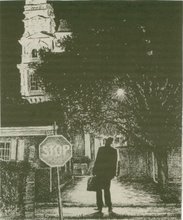
St. Peter's Fiesta


                                                                 (photograph by Ernest Morin)

( As Gloucester prepares for another Fiesta week, beginning on Wednesday, June 25,  2014, I re-post an essay, first written in 2002, to commemorate the annual celebration that has very special meaning, not only for the city's Italian fishing community, but for our collective sense of ourselves as a people.  Fiesta will have a more urgent significance this year because its home, the iconic Fort neighborhood of Gloucester, is endangered by the imminent construction of a hotel at the former Birdseye plant on Commercial Street, accompanied by infrastructure repairs that, along with the hotel itself, will change the face of this historic neighborhood.)

Italians have two principal verbs for walking. “Camminare” means simply getting about on foot, while “passeggiare” has the more formal connotation of taking a stroll. As a noun “passeggiata” also means promenade, as of an evening’s stroll along the boulevard or in the populous square of a Sicilian town. Since the advent of the automobile, “passeggiare” can also mean going for a drive.
I’m reminded of these words at St. Peter’s Fiesta as I watch the strolling crowds of children and their parents--brightly dressed teens, kids on scooters, even skateboarders--converging on the square that has been home for 80-plus years to Gloucester’s most profound celebration of our collective identity.
La Festa di San Pietro is many things. It pays homage to the patron saint of Gloucester’s Italian fleet and it’s also a Solstice celebration. As winter and spring give way to summer, fishermen and their families thank St. Peter for what the sea provides. Competitions like the dory races and the greasy pole contest have their origins in ancient games of strength, whose deeper roots lie in Greek, Sicilian and Near Eastern fertility rites. The climax of the celebration is the blessing of the fleet; and its denouement is the late night procession during which the statue of St. Peter is carried by fishermen and their family members through the streets of the Fort and returned to its resting place in St. Peter’s Club.
One doesn’t have to travel to Italy to understand this powerful annual event. Much of Italy has been transported to Gloucester and remains here in the traditions of our Sicilian community through folkways like St. Joseph’s Feast and the yearly novenas of the Mothers of Grace Club on Washington Street. For that reason, living in Italy often seemed to me like being home in Gloucester. A great deal of what I experienced during the years I spent as a graduate student and teacher in Florence, or on my travels throughout the country that remains my spiritual home--men drinking coffee and talking politics in cafes, widows dressed perennially in black, children kicking a soccer ball in the street--was familiar to me from growing up here.
That is why I love the idea of Fiesta. As long as there is an Italian community to celebrate it and fishermen to be honored, Gloucester is still Gloucester as we know it.
Fiesta is rite and ritual, it is games of strength and skill. It’s a giant block party and mating dance as young people from all over the city meet and mingle. But Fiesta is also Gloucester’s great annual passeggiata. It’s the place where everyone strolls through the Fort, among the carnival booths, the rides, the games of chance. There is food in abundance-the sizzling Italian sausages and hot peppers, fried dough, cotton candy, candied apples. Fiesta is where old friends and relatives meet, where kids home from college or the service, from jobs in other towns, reunite. It’s where the winter’s babies are proudly displayed and where newly married couples, or those about to be married, declare their love.
Passseggiata in Italy has, from Roman times, been a traditional public ritual. During the evening stroll eligible sons and daughters gave each other the eye under the attentive gaze of parents. The poor observed the habits of the rich, while the rich prided themselves on their ability to set examples of decorum. Confined mostly now to small towns (although the custom still prevails in Naples and Palermo, and Romans have long had to share Via Condotti, Villa Borghese and the Piazza di Spagna with tourists), passeggiata has largely given way to those drives in the car that its secondary meaning describes, or simply to the new life of bar hopping, movies and night clubs that has become the international pastime of young people no longer restrained by parental authority.
Yet in Gloucester passeggiata continues as an integral part of St. Peter’s Fiesta. It remains as I remember it from childhood, when our mothers accompanied us to the Fort. One of the passages into adolescence was to be allowed to attend Fiesta alone or with friends. In high school one strolled among the carnival booths with one’s steady date. Indeed, it was de rigueur to show the world that one had a girlfriend or boyfriend.
Fiesta has changed over the years. Some natives lament the midway atmosphere, which appears now to overshadow the religious dimension of the celebration. But part of every spiritual ritual, like Mardi gras, involves both worship and release. What’s important is that after 87 years we still have Fiesta and that it draws the community to our one big public square. Here, under the watchful eyes of St. Peter, we recommit ourselves to the sacredness of Gloucester’s central occupation, that of fishing and the maritime life.

Wednesday, May 9, 2012

Assault on Fort Immoral, Unethical


(What follows is the text of the testimony I was prevented from delivering in full at the Gloucester City Council's May 8 public hearing on the Fort hotel overlay district zoning (HOD) that would pave the way for the construction of a luxury hotel and conference center at the site of the historic Birdseye plant on Commercial Street.)


This is the third assault on a neighborhood that has given, and continues to give, so much to Gloucester.   The continued attempt to jam a hotel into an economically viable and socially and historically rich part of our city is not only poor planning, it is immoral and unethical.  It is poor planning because it occurs at a time when the city’s Master Plan is ten years out of date.  It is immoral because you do not target one neighborhood three times for radically inconsistent and potentially damaging developments, like hotels and condos, and then attack the residents and business owners for attempting legitimately to protect their lives and their livelihoods.
What community in its right mind would be talking about a hotel on the Fort when we haven’t looked at our future in a comprehensive way for over a decade?  More fundamentally, you do not put the cart before the horse.  You do not plan by zoning or rezoning; you zone through planning.  Zoning was created to protect existing uses and to allow them to grow and prosper in safety, not to undermine them as this proposed hotel overlay would do, creating chaos in its wake.
The city is not bankrupt and we have an excellent bond rating, so there is no reason to rush into development without taking the long view and achieving the kind of consensus a community needs.  For without that consensus we will have years of haggling and dysfunction. 
One hotel on the Fort will not appreciably increase the city’s tax base or make our schools any better; nor will it provide the full-time jobs with benefits that maritime and other industries provide.  What will increase the tax base and provide for excellence in education is comprehensive planning.
Those who believe that a hotel can be contained without consequences in a marine industrial neighborhood are seriously mistaken.  One overlay request will lead to another, both on and off the Fort.  The current developer already owns other parcels on the Fort, and at least one more Fort property owner has already expressed a desire to apply for an overlay for his property.  Make no mistake, there will be a domino effect, and it could reverberate throughout the waterfront and the entire city.  It has already begun to happen on the Back Shore, with yet another area of conflict opening up.
There will be social and economic consequences as well, as residents and business owners on the Fort are squeezed.  To treat Gloucester’s most iconic neighborhood—the home to the some of the city’s most successful and viable marine industries and a place that draws thousands of visitors and has inspired generations of artists—like a pariah is not only wrong from a planning perspective, it is unethical.  We should be praising and supporting these local Fort businesses for what they bring to the city in real products and wages, rather than damning them for presumably standing in the way of progress.
            We need a downtown hotel.  There is a welcome consensus on that issue.  Good planning will help us to find the appropriate location for it.  Planning and patience—virtues that are necessary for sustainable growth—are what we need just now, not knee-jerk reactions to overlay zoning or a hotel where it doesn’t belong and where it will create more problems than it will solve. 
The groundwork has been laid for a new Master Plan with the Harbor Development plan, the Mt. Auburn Report and the Maritime Summit.   However, the Harbor Plan is slated for revision and the Mt. Auburn and Summit reports are recommendations not plans.  They need to be integrated into a rigorous Master Plan through an inclusive public process with maximum citizen input.  Otherwise, we will spend years in meetings like this locked into debilitating arguments rather than working together to help our community grow and prosper.
The city is not in an active, creative mode.  Instead, we are reacting to what others propose or try to impose on us.  This does not make good economic sense, nor does it foster a community’s sense of well-being.  We must take control of our future.  We can only do that by declaring a moratorium, a conflict-free space in which we can heal and plan for the potentially rich future this city faces, a future we must create together not allow to be created for us by the demands of others.  It is the responsibility of the City Council—you, our elected representatives—to exercise due diligence and to protect us from those demands that may on their face seem worthwhile, but will, in the end, prove even more divisive and damaging.
For these reasons, I strongly oppose the proposed Hotel Overlay District zoning for the Fort and I urge you to vote against it.
Thank you.


Friday, April 27, 2012

Gloucester on the Brink


The Fort is the choke point.
Break it, the walls come tumbling down.

--Gloucester native


What does one do when you feel that the integrity of the place you love more than any other, the very place you know as home, is threatened?

            I’m talking about my birthplace, Gloucester, Massachusetts, America’s oldest seaport.  The threat I’m referring to is not a natural disaster, like a hurricane or tornado, but the determined effort of a billionaire developer to build a luxury hotel and spa in the heart of the city’s iconic ethnic and marine industrial neighborhood, known as “The Fort.”
            “What’s so bad about that?” you will ask. Clearly there must be a need for a hotel in a community that has long catered to visitors.  A new hotel on or near the waterfront would create new jobs while adding to the city’s tax base.  The hotel’s proponents claim that those who oppose it are living in a past where fishing once drove the city’s economy but is now severely compromised by the collapse of traditional stocks and federally imposed conservation regulations.  This is a misleading opinion.
Those of us who see a hotel on the Fort as inappropriately close in proximity to marine industries that already bring $80 million dollars into the city, are not against hotels.  We understand that Gloucester needs a year-round hotel that would cater to tourists as well as to travelers to the city’s many businesses and industries, though we believe that fishing is not dead and there is a better future for the community in marine and bio-tech research and development than in luxury tourism.  There are also more suitable places to situate such a hotel within the downtown.

The Fort, named for the Revolutionary era fort it once was home to, and later settled by Irish and then Sicilian immigrants, who worked in the marine industries, is not downtown.  It’s a well-populated peninsular with multi-family dwellings at the entrance to Gloucester’s inner harbor, accessed by one narrow road.  The site where the hotel is planned contains the legendary white-towered building, where Clarence Birdseye developed the flash freezing method for fish. At first glance, it appears to be ideal for such a project.  It fronts a public beach and the beautiful outer harbor of Gloucester with views out to Boston.  However, putting a luxury hotel alongside of fish plants has never been considered a sensible idea.
After proper examination, there remain serious drawbacks, including adverse economic and social impacts on the neighborhood. Residents, many of whom have lived for generations on the Fort, fear the end of their traditional working class life, which includes the annual celebration of St. Peter’s Fiesta that commemorates the birthday of the patron saint of Gloucester’s Italian fishing fleet.  They believe that a resort hotel with its upscale clientele and amenities will adversely impact their own daily lives and work.  Business owners, who are serviced day and night by trailer trucks, are concerned that the noise and traffic their businesses create, along with the strong smell of fish and fish by products, will elicit complaints by hotel guests, which will trigger their eventual eviction from the very waterfront property their businesses depend upon. Equally, they worry that the zoning tool, an untried overlay proposed by the hotel’s developer, could be duplicated throughout the waterfront or city itself with deleterious effects.  Zoning experts have argued that the proposed measure violates the Scit doctrine, which calls for basic zoning uniformity of a street or district.
More crucially, Gloucester is a city at a crossroads.  Our Master Plan is outdated by ten years and there has not been an integrated effort to bring the community together to create a consensus for the city’s future. As a consequence, we have been subjected to the whims of developers, who have taken advantage of our economic uncertainly and lack of planning to impose their own visions on a divided community. The imposition of such a radical zoning measure on a vibrant neighborhood like the Fort is clearly unethical--it may even be illegal.  Moreover, it violates all the accepted rules of planning.  A community does not plan through zoning, it zones through planning.  Why would any city in its right mind reverse the process?  Furthermore, the city is not bankrupt and we have an excellent bond rating.  So why rush to develop without planning first?
Prize-winning author Mark Kurlansky, whose The Last Fish Tale (2008) urged Gloucester not to undermine its identity as “American’s oldest fishing port and most original town,” has warned us once again not to go the way of so many seaports that have sold their souls to become resort communities, only to regret it.
 Speaking recently before a capacity crowd at the Gloucester House Restaurant, Kurlansky exhorted his audience not to let tourism with its seasonal economy overwhelm Gloucester’s gritty blue collar marine industrial character.”
 “Fishing and marine industry is your heritage,” he stressed.  “Your heritage is your identity, your brand.  Once you destroy your brand there’s nothing left to attract people to the city.”
Under the surface of these concerns lie class issues, which have national implications, especially in the light of the recent Occupy movement.  Gloucester is known world-wide as a gritty, blue collar community.  It is largely for this reason, for its authentic labor-intensive environment of fishermen, fish cutters and packers and dock workers, that thousands of tourists visit each year, along with many acclaimed artists, beginning with Winslow Homer, who came to capture both the activity of the waterfront and the city’s unique light (since the 19th century Gloucester has been both home and a vital inspiration to countless visual and performing artists).  Writers equally charmed by the city’s maritime history include Rudyard Kipling whose Captain’s Courageous depicted the lives of fishermen under sail in an earlier Gloucester, and The Perfect Storm’s author Sebastian Junger, who dramatized the perils of present-day fishing.
For generations natives co-existed with enclaves of wealthy summer residents, who built houses on Eastern Point and in Annisquam, outlying areas of the community.  These “summer people,” as they were called, provided employment for natives.  They shared local amenities like beaches, while respecting the native’s right to pursue their own lives.  But with the spread of condominiums and a burgeoning economy that allowed for the purchase or construction of high-end properties, a new and increasingly affluent class of people came to live in Gloucester, very different from the old money that had summered here beginning in the 19th century.  Unlike the old moneyed residents, this new class has made demands on the city for lifestyle amenities of their own—expensive restaurants and specialty boutiques—demands which have slowly changed and gentrified a city whose residents have long been comfortable living and working in as it was.
There is, however, a deeper concern.  It is a fear that our working waterfront and the full-service port that has defined this city for centuries and been our lifeblood is being targeted for development that has nothing to do with fishing and maritime activities.  After Jim Davis, the owner of New Balance shoes, bought the Birdseye building to develop it as a hotel, he purchased two more properties on the Fort and is said to be negotiating for a third, suggesting a wider takeover of the neighborhood, which could lead to the gutting of existing businesses and residences.  Davis also owns another property at the eastern end of the working waterfront.  In addition, he is the controlling partner in Cruiseport, a restaurant, function center and seasonal docking venue for vacation cruise ships, located on a wharf that once provided stevedoring services to tankers carrying international cargoes.
If Davis is allowed to construct his hotel complex on the Fort, residents fear a domino effect, which would concatenate across the entire working waterfront, transforming it into a retail and hospitality center, our highly experienced workforce displaced by underpaid service employees.  Already demands are being made to lift the state Designated Port Area (DPA), which protects both the fishing industry and water-relate businesses.  Should the DPA be lifted, other uses such as restaurants, condominiums, retail businesses and marinas for luxury yachts could preempt marine industrial uses.  Gloucester’s much sought-after full-service port, with its state of the art railways for ship repairs, its fresh fish auctions, machine shops and other industries ancillary to fishing would be lost.  Along with that would go the city’s storied character and maritime heritage, which continues to attract a multitude of visitors, who come not for hotels and condos but to experience our famed working landscape.
Kurlansky is right.   If what he cautioned against were to happen, not only would there be little left for the people who live here to base their lives on, but our proud heritage created by waves of Yankees, Novascotians, Lebanese, Finns, Greeks, Jews, Portuguese and Sicilians, who came to this working port for living wages and stayed to create neighborhoods like the Fort, will have been irretrievably altered.  Place is more than simply where we live.  Place is who we are and what we are.  It is, as the Gloucester poet and former Fort resident Charles Olson maintained, “the geography of our being.”  Destroy place and you destroy the very basis of our lives. In an over-mediated world where people yearn for authenticity we have it in abundance here in Gloucester.  Why would anyone want to barter it away?

April 30, 2012:    Two motels on Gloucester's Back Shore have just applied for a zoning overlay that would enable them to expand, spawning a second campaign against this problematic form of zoning; in this case by residents of the Back Shore and Eastern Point,  who oppose a hotel overlay in their neighborhood.  Some of these same residents favor the hotel overlay zoning proposed for the Fort. Consequently, two neighborhoods are pitted against each other, in a further instance of poor or non-existent planning.  The domino effect, predicted by those who oppose overlays on principle and urge the city to plan before allowing haphazard development in any neighborhood, appears to have begun.
_____________

Monday, March 19, 2012

Jack Kerouac Comes to Gloucester


So far as I’ve been able to learn, Jack Kerouac came to Gloucester only once. Charles Olson told me the story, for it was Olson, the poet, that novelist Kerouac paid a call to one night in late October of 1968.
There was much talk of Kerouac that fall. Jack had just published what would be his last full-length novel, the haunting Vanity of Duluoz, which picked up the story of his life—he preferred to call it “the legend of Duluoz” and compared himself to Marcel Proust, claiming that his own work comprised “one vast book like Proust’s, except that my remembrances are written on the run instead of afterwards in a sick bed”—from the years between his football star days at Lowell High School and his even briefer stint as a scholarship student and football whiz kid at Columbia College under coach Lou Little; and those spent roaming the country he’d already written about in his bestselling novel On the Road.
Harvey Brown, the publisher of Frontier Press books in West Newbury, had obtained an advance copy of Vanity of Duluoz, and had immediately gotten on the phone to read parts of it to Olson in Gloucester. Olson told me he was pleased Kerouac was again writing about what was closest to him, his origins and his life in Lowell—and he was doing it in Lowell, where he’d returned a few years before, at the age of 45, to marry Stella Sampas, the sister of his late best friend Sammy, and set up housekeeping again in a home he’d bought for his wife and his mother on Sanders Avenue, across the river from Pawtucketville, in the southwest part of Lowell. Olson also told me that he believed Kerouac was writing some of the most important prose in America.
Although Kerouac is best known for his “Beat” or “Road” novels, books like On the Road, The Subterraneans, The Dharma Bums, Big Sur and Desolate Angels, which constitute a prose chronicle of the lives of some members of what the Media, after Kerouac, had come to call “The Beat Generation,” his biographer Ann Charters reports that his own books which were dearest to him were all set in Lowell, Massachusetts, the city of textile mills on the banks of the Merrimack River.
Since Kerouac’s death more attention has come to be focused on the Lowell novels, Visions of Gerard, Doctor Sax and Maggie Cassidy. And it is to these books that I would call the attention of new readers of Kerouac; for I know of few books in American literature where what it feels like to grew up in a small town or city in the 1930s and 40s, among an immigrant population, in working class neighborhoods, is as accurately and movingly rendered, as Kerouac has managed to do, particularly in a manner that differs radically from previous native writing.
Rather than the usual American realism or naturalism, in the Lowell novels you have instead a Proustian sense of the recapturing of lost time, often the most delicate sensation of how the intermingling of memory and dream, intuition and recollection, gives a deeper and far more penetrating vision of a time, place, person or thing than any cinematic or purely photographic depiction. As far back as the 1940s, Kerouac had a deadly serious notion about the kind of writer he wanted to become, telling his father, Ann Charters writes, that he planned “a lifetime of writing about what I’d seen with my own eyes, told in my own words. . .and put it all together as a contemporary record for future times to see what really happened and what people really thought.”
Doctor Sax recounts the story of a young man’s coming of age, his loss of innocence and his initiation into the mysteries of good and evil, death and rebirth, against a symbolic backdrop of Depression-era Lowell and the Great Flood of 1936. Maggie Cassidy, is a tender, almost wistful recollection of a high school romance. In both, it is not only the actual events that Kerouac’s prose recreates and enacts, but also the atmosphere surrounding them—including the slang that was spoken, the songs sung, the radio programs listened to, the magazines read and the products consumed—animating them as they filter through the consciousness of his narrator-protagonist. “The whole thing,” as Kerouac wrote, “seen through the eyes of poor Ti Jean (me), otherwise known as Jack Duluoz, the world of raging action and folly and also of gentle sweetness, seen through the keyhole of his eye.”
To get back to Olson’s—and my—story, I’d gone over to Charles’s at 28 Fort Square a couple of days after the Kerouac visit to help him celebrate the publication of a major book of his own, the second volume of The Maximus Poems, which had just been released by Cape Goliard Press in London. The first thing Olson said to me after I told him I’d been up all night reading the new “Maxies,” as he called his Gloucester epic, was “You missed your man.”
 
“What?”
“Kerouac was here.”
“Jack came to Gloucester and I missed him?”
“That’s right.”
I was crushed, and disappointed, for I’d long wanted to tell Kerouac in person just how much his books meant to me. Harvey Brown and I had talked about going to visit him in Lowell, but Kerouac had moved yet again before we could act on our plan. To console me—and also because he relished telling it—0lson told me the story of the visit.
He’d been in his kitchen. It was a mild October evening and he had either the windows or the kitchen door open. He heard someone calling his name—“Olson! Charles Olson!”—in a kind of drunken singsong voice. He went to the door, stepped out upon that back porch from which you could see the whole city of Gloucester, eerily that night under the spell cast by the mercury vapor street lamps the poet so hated—“they destroy the color of color in human faces,” he had written his “Scream to the Editor” of the Gloucester Times.
Olson made out three figures in the gloom at the foot of the long staircase to his second floor apartment, and the one who’d called his name was now shouting, “The red carpet treatment. I expect the red carpet!”
Olson immediately recognized Jack Kerouac (whether or not they’d ever met before he never told me), disappeared into his kitchen and returned with the first thing he’d grabbed, which turned out to be some pages from the Boston Globe’s Sunday magazine section. Down the steps the massive poet plunged, and he slipped the pages under Kerouac’s knees, while the novelist proceeded to negotiate the stairway on hands and knees, Olson alternatingly removing the paper and slipping it back under Kerouac’s knees, until they’d made their way laboriously to the top of the stairs and across the porch to Olson’s kitchen door, whereupon Kerouac entered, slumped down into a kitchen chair and asked for a drink.
I can’t remember Charles telling me what they talked about, or if they ever did talk. At some point Kerouac, who was already drunk (he’d written earlier that year in Vanity of Duluoz, “If I myself, for instance, were to try to follow Jesus’ example I’d have first to give up my kind of drinking, which prevents me from thinking too much, like I’m doing now in awful pain this morning, and so I’d go insane and go on public debt and be a pain to everybody in the blessed ‘community’ or ‘society.’ And I’d be furthermore bored to death. . .”) either passed out or was assisted back to the car by the two men who had come with him. They turned out to be his Greek-American brothers-in-law from Lowell; and Olson, who knew a slew of Greeks between Gloucester and Washington, D.C., reported spending the rest of the night absorbed in animated discussion with them, while Jack slept off his liquor downstairs in the car.
It wasn’t until long after the Kerouac caravan had set off for Lowell that Olson noticed the Boston Globe magazine pages he’d red-carpeted Kerouac with lying on the floor of his kitchen, and, picking them up idly, found that Kerouac had come up Olson’s steps on hands and knees pressing down upon the very article that Kerouac himself had just written. In it, Kerouac, who had for ten years been trying to get rid of the “Beat Generation” label, which he felt had kept his books from the serious critical attention accorded other writers whose books weren’t nearly as innovative and truthful as he believed his to be, disavowed any kinship with the current generation of “Hippies” and student rebels, he, as an “Apostle of the Beat,” had been accused by the Media of fathering. He had—prophetically—entitled his article “After Me, the Deluge,” but the magazine editors had re-titled it, “I’m a Bippy in the Middle.” The compound irony hit home for many of us.
Shortly after his visit to Olson, Kerouac moved from Lowell to St. Petersburg, Florida so that his ailing mother could be in a warmer climate. A year later he was dead, as the newspapers reported, “of a massive gastric hemorrhage,” and his wife Stella insisted, of loneliness.
Two months later Olson died, in New York Hospital, of cancer of the liver. Both men died away from the places that had nourished and sustained them, and which figured centrally in their works as well as in their lives.
Allen Ginsburg spoke to friends at Olson’s funeral in Gloucester of a sense of “an ending of something,” and of an uncanny feeling he’d had of having come almost directly from burying Kerouac in Lowell to inter Olson in Gloucester, though the two funerals were about two and a half months apart. Later, in an “Eclogue,” he wrote: “Kerouac...Olson, ash and earth.”
And many of us did have a sense then, under the terrible strain of those Vietnam years, of an ending of something, of a dream maybe, a promise, that we all had, of a possibility, an idea of America, which Kerouac and Olson, each in his own way, had reminded us of; had, in their work and in their visions, held us and our country to.
I went home from Olson’s funeral to write in my journal:
“And now it seems I am back where I began. The two American writers I most loved and respected are dead: Olson of cancer, Kerouac of drink. With their deaths a force seems to have gone out of my own life, a pungency from the very air of New England. Reading Doctor Sax and Maggie Cassidy, Kerouac’s two neglected Lowell novels, had freed me of the old prose stance and taught me the possibilities of a lyric repossession of the authentic past, while Olson pointed me into the future with the tool of mythology as epistemology not art-form, and the fix of self.
“It was a good feeling to sit up here on Thomas Riggs’ hill in Riverdale, knowing that Charles was down in his house at the Fort overlooking the harbor and that Jack might well have been working away in his bedroom in Lowell not far from the woods where Thoreau had lived and walked. I often thought of us as ‘spies of all the gods,’ in Allen Ginsberg’s phrase, a kind of Massachusetts brotherhood of the Craft, though we were never together in the same room and I never did get to meet Jack.”
(This is the text of a talk I gave on March 12, 2012 at the Gloucester Writers Center, to celebrate Kerouac's 90th birthday.)

Sunday, February 19, 2012

Peter W. Denzer, 1921-2012


I, too, forget

and over years

learned the grammar

of daily ruckus.

Growing deaf to the racket

of our time,

I now hear voices

of leaves and stones and stars.

-Peter Denzer

Peter Denzer and I first met in Brunswick, Maine during the fall of 1957. I was a junior at Bowdoin College and an aspiring writer; Peter had just published his third novel, The Last Hero. He and his then wife, Ann Sayre Wiseman, a painter, writer and illustrator of children’s books, lived in an airy flat in a 19th century redbrick apartment building, a block from the Cabot Mill and the Androscoggin River, which had once been the abandoned factory’s principal source of power. You could hear the roar of the river from the Denzer’s front living room.

Up each morning at first light, Peter was at that time working on his fourth novel, The Diggers, a narrative of hardscrabble life on the coast of Maine, to which Peter and Ann had moved the previous spring from New York’s Greenwich Village. In a study not much bigger than a closet, he wrote until noon on a big green manual typewriter set on a wooden packing crate. After lunch with his family, Peter would leave the apartment and stroll down Maine Street to Fairfield’s Book Shop, directly across from the Bowdoin campus, where from 1 p.m. until closing time he was the manager, eventually transforming an already popular and well-stocked book store into the town’s principal intellectual and artistic meeting place.

Besides working at Fairfield’s, Peter wrote a couple of “potboilers” and a series of magazine articles to make ends meet. He also broadcast a noontime weekly radio talk and interview show from the Harriet Beecher Stowe House, the town’s premiere restaurant and inn. When Grove Press published the first unexpurgated American edition of D. H. Lawrence’s Lady Chatterly’s Lover, in 1959, Peter invited me to discuss it with him on the air. I needn’t report on the wave of outraged comments the Bath-Brunswick radio station owners were inundated with in tight-laced Maine!

Tall, handsome and Hemingway-bearded, Peter was the kind of writer I and my literary friends on campus hoped to become. Though his first three novels had been well received (all were favorably reviewed in the New York Times, the Washington Post and the San Francisco Chronicle), we admired his honesty about having to make a living in the real world; and we were especially attracted to his savvy regarding agents and publishers and his progressive politics, both an antidote to what we were getting from teachers whom the McCarthy Era had made gun-shy about sharing their own ambitions and beliefs.

Born in 1921 in New York, to a Jewish physician father and an Irish mother from the Mid-West, Peter grew up in the city. He attended public and private schools and entered Oberlin, where he met novelist and conservationist Louis Bromfield, who wrote books and farmed, occupations that Peter would later combine, first on a 100-acre farm he bought with the help of a G. I. Loan, in 1959, in Richmond, Maine, and later with his wife Mary, in Houston, Minnesota. Bromfield proved to be an early influence on Peter’s life-long ecological ethos.

Leaving Oberlin in 1939, Peter worked as a farm and factory laborer, experiences that he would later make use of in The Last Hero. He attended Syracuse University before serving in the U. S. Army Medical Corps until 1941. After military service, Peter embarked on a career in journalism, beginning as a Washington correspondent for Transradio Press, United Press International and Broadcasting Magazine, where he covered all beats, including The White House, Congress and the Supreme Court. Peter also contributed articles and reportage to the progressive New York daily newspaper PM.

In 1945, as a result of his journalistic experience and his command of German, Peter served as a political advisor to the staff of Ambassador Robert P. Murphy at Supreme Headquarters Allied Expeditionary Force (SHAEF), in Germany. Following that appointment, he became director of the American News Service, in Vienna, and editor and publisher of The Daily American, the first privately published, independent English language daily newspaper in post-war Germany. Before leaving Europe in 1950 to return to the United States, Peter also served as director of Stuttgart Studio AFN, in Germany. Peter was one of the first journalists to enter Dachau after it was liberated by the Allies and he never forgot what he saw there.

Upon his return home, Peter continued his career in broadcast journalism, first at WWJ in Detroit, where he produced the radio documentary “Listen Detroit,” and then as news director at WPAC-Ann Arbor and WRIT-Milwaukee. During these years Peter was married to the late journalist and TV producer Beryl Schoenfield, and they had two sons, Peter and James.

In 1954, Peter’s first novel, Episode, the story of a young soldier’s struggle with mental illness, was published by E. P. Dutton. It was followed the next year by Find the Dreamer Guilty, also published by Dutton, about two teenage boys involved in a sensational murder. By this time Peter’s desire was to devote himself entirely to writing. Returning to New York in1956, he lived in the Village and Long Island while working on The Last Hero, a searing coming-of-age novel set in Upstate New York, published in 1957 by Henry Holt and Company. A visit to friends in Robinhood, Maine led to a meeting with renowned sculptor, William Zorach, which rekindled a childhood wish to work in wood, stone and clay that would not be fully realized until Peter moved to Italy in 1960. That visit also inspired Peter to leave the city for what he hoped would be a simpler and less expensive life in Maine.

After graduating from Bowdoin in 1959, I moved to Florence, Italy to study Medieval Literature at the university. A year later, Peter, his wife, and sons Piet and Kiko, joined me so that Peter could research and write a novel based on the life of poet Ezra Pound, who had lived for many years in exile in Italy. We shared a small villa in the Tuscan hillside village of Settignano, where Peter completed “The Alien” and I finished my own first novel. In 1962, I returned to America, but Peter remained in Florence, where he met the American artist Mary Alexandra Milton—“Maria”—who would become his wife.

Living in an ancient palace, on Via dei Rustici in the heart of Florence, Peter and Maria shared a remarkable life. Continuing to write and publish, Peter also carved from the native stone and modeled in clay, while Maria produced paintings, drawings and sculpture. In 1969, the couple returned first to New York, where they worked in publishing, and then to Maria's native St. Paul, where Maria was apprenticed to the potter R. Broderson, later teaching Peter the art of throwing and glazing. On Grand Avenue, in St. Paul, Peter and Maria founded Front Porch Pottery and Gallery, where they exhibited and sold their own pottery, subsequently relocating their workshop to the farming community of Houston, where they continued to live self-sufficiently while participating in the life of the community.

Known after his career in journalism primarily as a writer of fiction and essays, Peter had also made a reputation as a poet, publishing poetry in anthologies and literary journals. Poetry, however, was not a second art for Peter, something he’d done with the left hand while writing fiction with the other. From an early age Peter had written poetry in parallel with fiction and essays, each genre inspiring and influencing the other. When I first knew Peter, he would read his poetry to a group of us after dinner in that art-filled apartment on Maine Street, in Brunswick. And later, when we corresponded for many years (I shouldn’t forget Peter’s brilliant, informative and witty letters as yet another of his literary accomplishments), Peter would always share his latest poems.

Peter’s poems are often the compact statements of what he would dramatize in fiction or write critically about in essays and letters. They are at once personal and political, lyrical and didactic. What he felt he couldn’t express in prose he found words, images and metaphors for in poetry, in a voice that is equally as strong and distinctive as his prose voice. Peter’s journalism, which brought him into immediate contact with the world and its workings, informed the powerful realism of his fiction, just as his work in each of those genres informed his poetry. But the poetry is where this man, who was both passionate and rational, went to feel—to express what he couldn’t say in prose. In the end, all of Peter Denzer—his passion, his rationality, his political commitment, and his love for an endangered earth and all its creatures—can be found in the poetry. The poetry is the synthesis of his life and work, a cry, as Peter has written, "against ugliness imposed on the planet’s fragile life system by war, greed, and ego unhinged by fear and the mystery of beginnings and endings.”

Peter, who had been suffering from the effects of Parkinson’s disease, died at the age of ninety of congestive heart failure, on Monday, February 13, 2012, at the Valley View Healthcare and Rehabilitation Center, in Houston, Minnesota. Maria, his beloved wife of nearly 48 years, was at his side. Before his death, Peter completed his final book, a memoir on which he had been working for several years. This essay will be part of an introduction to Peter's memoir to which I and other friends have been asked to contribute.

Saturday, July 2, 2011

Hemingway's Death Fifty Years Later


I can remember exactly what I was doing fifty years ago today, on July 2, 1961. I was walking through Piazza del Duomo, one of the main squares in Florence, Italy, on a hot early summer morning when I saw the headline on a newsstand: `E MORTO HEMINGWAY. He was one of my heroes, as the recently deceased Albert Camus had also been, and I stood there frozen in front of the headline. As soon as they noticed it, the people in the piazza around me paused in silence. Those who wore hats took them off; others bowed their heads and crossed themselves. Italians considered Hemingway one of their own. He had been awarded medals for his service on the Italian front in WWI and they loved his novels and stories, especially those with Italian settings.
I was twenty-three years old. I had been living in Florence since the fall of 1959, studying Medieval literature at the University and teaching English at the International Academy, a private school for high school graduates and college students, who wished to pursue careers in diplomacy. Writers like Hemingway and Camus, whose classically paired down French prose was influenced by Hemingway’s, were very important to me as a budding writer. I had already completed my first novel, set in Greece, and I was working on a second, set in Florence, involving a love affair gone awry between a young expatriate couple.
I had been reading Hemingway since ninth grade. There were passages in The Sun Also Rises and A Farewell to Arms, as well as from some of his stories like “In Another Country” and “A Clean, Well-lighted Place,” that I knew by heart. The Hemingway who had inspired me to write was not Hemingway the big-game hunter or Hemingway the adventurer of later years. It was the early Hemingway, the young writer, who had learned his craft in 1920s Paris, surrounded and influenced by important avant-garde writers like Gertrude Stein, James Joyce and Ezra Pound. I had gone to Europe not so much to study literature as to imbibe the cultural, artistic and intellectual atmosphere that had nurtured the Lost Generation of writers and artists I admired as an undergraduate, reading everything I could find about their lives and their work habits. I chose Florence not Paris because I also wanted to study the poetry of Dante and his contemporaries on the very ground of its creation, in the original language.
Still, I had followed Hemingway’s later life in newspapers and magazines. I continued to read his more recent novels and stories, and I had been thinking of him a great deal as I devoured the novels and stories of the late Cesare Pavese, an Italian writer, who was much influenced by Hemingway’s style and sensibility, and who had committed suicide himself in 1950.
I can’t imagine what sort of impact the death of a master like Hemingway might have on an impressionable young writer today, although I’m aware of how the recent death of the incredibly gifted young novelist and philosopher David Foster Wallace had on many writers of his generation. Though I had not read a lot of Wallace before he died, I, too, was devastated by the news of his suicide, saddened as I also was about the promising life that was cut short.
When Hemingway’s death was first announced, it was suggested that it might have been accidental, that the shotgun that had killed him had gone off when he was cleaning it. But those of us who knew Hemingway through all his novels and stories , though we might not have known much about the depression he suffered in the years leading up to his death, or the terrible bouts of paranoia that his later biographers described, knew, or intuited, that he had ended his own life. His suicide was the stoical act of a Hemingway hero, a man who had pushed himself to the limits of human endurance and, in the process, had understood that when something was over—a love affair, a battle, a life—it was over. Given his depression, exacerbated, as we later learned, by an array of physical and psychological symptoms, not to speak of alcoholism, it could not have been easy for Hemingway that he seemed no longer able to write. Nor that he had been forced to leave Finca Vigia, his great home and refuge in Cuba since the 1940s, and was, at the time of his death, an exile in his native country, while also under surveillance by the FBI. (See today's New York Times op-ed page for a column by Hemingway's friend and collaborator, A. E. Hotchner, which corroborates the FBI surveillance).
After his death, Hemingway’s art was subjected to the critical eye of feminism, an important and perhaps even necessary reappraisal, though today some of the most astute and sympathetic critics and scholars of Hemingway are women like Rose Marie Burwell, Hilary K. Justice, Jacqueline Tavernier-Courbin and Debra Moddelmog. Nevertheless, his finest biographer, in my view, is Gloucester native James R. Mellow, whose Hemingway: A Life without Consequences is the benchmark against which all future biographical and scholarly work on Hemingway must be measured.
There was much that Hemingway taught us, we young writers, who dreamed of living and writing as he had. He showed us what a perfect sentence looked like and how feelings could be reflected by the things we described or that our character’s encountered. He helped us to understand the importance of place and the equally important precept that you did not need to say more than was necessary to set a scene or describe a character. Indeed, his greatest contribution lay in his teaching that what lay under the surface of things had as much or more dramatic impact as what one could immediately observe or report, and the writer's responsibility was to suggest it not tell it.
On this blog, on July 22, 2009, I posted my own appraisal of Hemingway on the occasion of the publication of a revised edition of A Movable Feast, Hemingway’s masterful sketches of his early years in Paris. "Hemingway Revisited" can be read at http://peteranastas.blogspot.com/2009/07/hemingway-revisited.html While neither complete nor definitive, it is my tribute to a very great writer whose work will live as long as we have literature and whose death, fifty years ago today, I remember with equal sadness.

Thursday, May 12, 2011

"Townie," by Andre Dubus III: A Review


Townie, Andre Dubus III, W.W. Norton & Co., pp.387, $25.95

Andre Dubus III, age 16, was walking through the student union building at Bradford College, in Bradford, MA, where his father, famed short-story writer, Andre Dubus, Jr., taught English and creative writing. Though it had recently admitted men, Bradford, was primarily known as a women’s college.

“So many of them were tall and slim,” the younger Dubus recalls many years later in Townie, his riveting memoir of coming of age in the dying industrial cities along the Merrimack River. “They had long straight hair and straight teeth and straight postures from what I imagined were childhoods spent riding horses and swimming and playing tennis.”

As he made his way to class that day in the early 1970s, a group of these students stood near a picture window that looked out over the well-tended green lawns of the college.

“That’s Dubus’s son,” he overheard one of the young women commenting to her friends: “Look at him. He’s such a townie.”

Though his famous father is dead and Bradford College has closed its doors, Dubus, now the highly acclaimed author of novels like House of Sand and Fog, cannot forget that slur.

“I’d heard it before,” he writes. “They’d used it for the men they’d see at Ronnie D’s bar…plumbers and electricians and millworkers.” Though not yet 18, Dubus was already a full-time college student.

“I enjoyed reading the books,” he writes, “but I was surrounded by people who seemed reared from comfort, most of whom knew where they were headed.” These privileged students all appeared to have aims for the future. “But I didn’t have any,” Dubus admits. “All I wanted to do was bench press 300 pounds and get so big I scared people, bad people, people who could hurt you.”

Townie is the gripping story of what led the son of a professor, who lived in the secluded comfort of a suburban college community, while his former wife and four children endured poverty across the river in working-class Haverhill, to seek strength and self-worth in body building. It’s the account of how a small boy who was bullied became a defender of himself and his siblings in a city where “kids roamed the neighborhood like dogs,” and teen-age girls “just gave it away.”

But this painfully honest memoir isn’t only the story of how a boy who grew up on the mean streets of Haverhill became an accomplished writer; or about how the way he learned to defend himself as a street fighter and trained boxer became both a salvation and potential damnation. It is, most urgently, about how Andre Dubus learned to transform the pain and violence that led him to become that fighter into words, which ultimately saved him. Townie, in all the immediacy of Dubus’s compelling narrative, is at its core a book about the paradoxically redemptive power of violence.

Dubus’s prose, and the distinctive voice it embodies, is the hard-won achievement of the author of three novels and a collection of stories. Its stunning tensions also reflect his father’s precision in matters of the heart, along with Jack Kerouac’s haunting descriptions of the streets of Lowell, so much like those Dubus himself lived and fought on in Newburyport and Haverhill.

Townie is more than a fine memoir. It is the record of a quintessential American life. Its bravura ending, tying together all the disparate strands of an often harrowing childhood and adolescence, is one that only a skilful novelist like Andre Dubus III could have achieved.

“Just go ahead and write,” his father once counseled him. And Dubus has done precisely that—brilliantly.

(This review appeared in the May 2011 "Literary Madness" issue of North Shore Art Throb.)